
An AI strategy for users, not builders
In focusing on adoption rates, is the AI for All strategy answering the right question?

AI for All
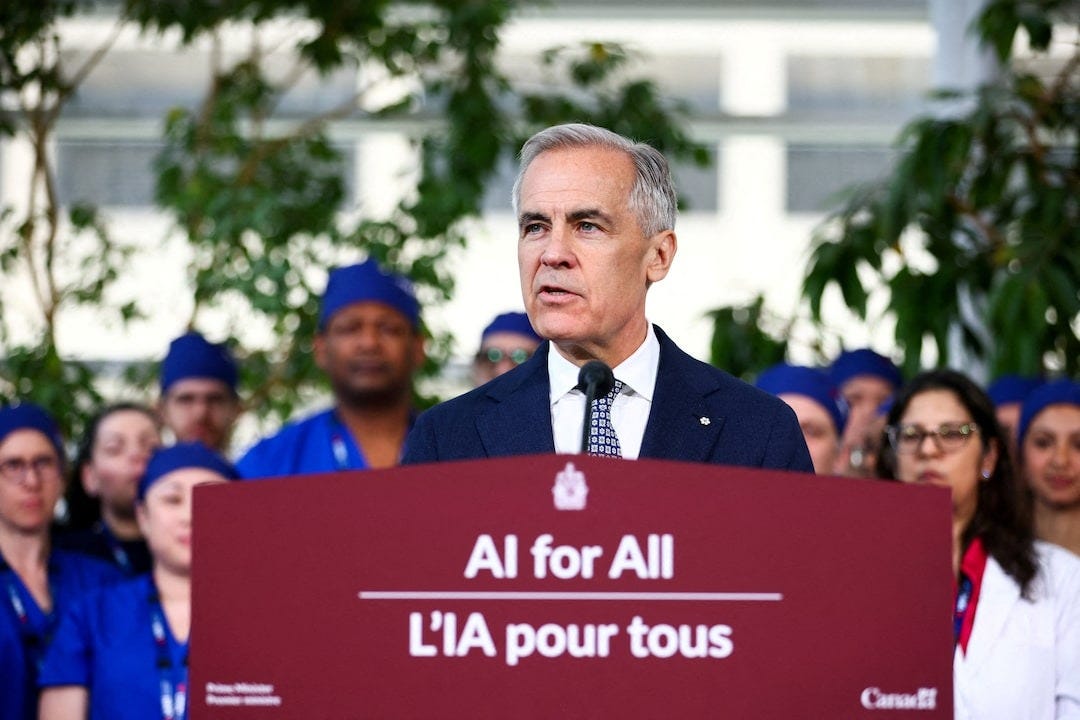
When it comes to artificial intelligence, the federal government faces a clear challenge, which is that Canadians are highly suspicious of it. That is almost certainly why Prime Minister Mark Carney chose to unveil AI for All, Canada’s new AI strategy, at a hospital in Toronto on Thursday. The facility uses AI to flag patients at risk of deteriorating overnight, which is just the kind of application that makes the technology feel like an opportunity rather than a threat.
A new Angus Reid survey released Friday morning reveals the scale of the trust gap. Nearly four in five Canadians (79 per cent) agree that companies using AI to replace workers should face higher taxes. On the technology’s broader impact, Canadians remain more negative than positive. A third of the public views AI as beneficial; 36 percent consider it harmful. As Carney himself acknowledged at Thursday’s launch, Canada “ranks near the bottom of countries in AI training, literacy and trust.”
That’s a telling concession from a prime minister whose new AI strategy has, as a central ambition, to get AI adoption by business from 12 percent to 60 percent by 2034. And that is why the three pillars of the strategy are trust, opportunity, and sovereignty.
On the trust piece, the government is promising privacy reform, online safety legislation, AI watermarking standards, and an expanded Canadian AI Safety Institute with a mandate to evaluate models. There will be a National AI Literacy Initiative, AI learning kits for 3,000 educators, and trusted AI agents for every post-secondary student. It’s not hard to see the theory of change here: if Canadians learn to use AI, and if guardrails are in place, trust will follow adoption rather than precede it.
The problem is that this might be addressing the wrong anxiety.
Consumer anxiety about AI threats — such as deepfakes, surveillance pricing, and chatbot harms — is real, and the regulatory measures are a reasonable response to it. But there is more that is driving the anxiety of that 79 per cent. It isn’t so much a worry about how AI works as about who benefits, and who will be left behind. An adoption agenda doesn’t speak to that; what would speak to it is a strategy that gives Canadians a genuine stake in AI’s success, not as users, but as builders.
That’s the disconnect at the heart of AI for All, and the Build Canada community has been pointing at the solution since the strategy was first being designed.
Last December, Ajay Agrawal submitted a memo to the federal AI Strategy Task Force that made an argument worth reading alongside Thursday’s announcement. Agrawal’s central point was that setting a target to become the ‘best AI country in the world’ is meaningless. AI is a tool, and success will be defined not by some quantity of uptake, but in how the tool is applied to real problems with measurable outcomes.
In his memo, Agrawal proposed five “AI moonshots” on things like healthcare wait times and wildfire response, with ambitious targets whose success requires both the application of AI and the coordination capacity of government.
The memo reframes the entire question that sits at the heart of Canada’s approach to AI. An adoption target is a metric for Canada as a consumer of AI. A moonshot is a metric for Canada as a user of AI to solve Canadian problems. This is a different thing entirely, and generates an entirely different solution set. Building the data infrastructure, the system integrations, and the AI-native institutions required to cut healthcare waits by 90 percent produces exportable knowledge, Canadian companies, and durable public-sector AI capacity. Hitting 60 percent SME adoption produces none of that.
To its credit, AI for All contains an AI Missions Program that puts healthcare first, then energy, agriculture, transportation, manufacturing, and robotics, and it is the closest thing to Agrawal’s moonshot logic in the official document. The first mission targets faster diagnostics, improved patient care, and system efficiency. And there’s real money behind it, including $200 million in the missions program and $100 million for a health sector data space. This is good.
But the missions are downplayed while the strategy’s headline goals remain adoption metrics. The missions are presented as applications of the strategy rather than its organizing principle. Invert that architecture, make the moonshots the frame around which compute, capital, and talent investments are organized, and you get a different document.
You also get a fundamentally different answer to the concerns of the 79 per cent. The government’s opportunity pillar is, at its core, a defensive offer: AI literacy programs, work placements, re-skilling courses for mid-career workers. It tells Canadians that AI is coming and Ottawa will help them adjust. A moonshot strategy proposes to put Canadians on the offensive: your hospital, your school, your wildfire-threatened community is the reason we’re building this. The distinction matters, because public trust in a transformative technology hinges on whether you believe the people deploying it are working on your problems.
This is not an argument against the strategy. There is genuinely good work in AI for All, especially the supercomputer investment, the missions program, the CIFAR expansion from 130 to 200 AI chairs, and the Sovereign Technology Alliance with Germany. Compared to the vacuum that preceded it, it is a serious document.
The argument is about what’s missing, and about sequencing. The trust pillar is designed to make Canadians comfortable enough with AI to adopt it. The opportunity pillar is designed to cushion the transition. Neither gives Canadians a reason to want to build it, and that is the only sustainable answer to the anxiety those polling numbers are expressing.
Adoption is a response to change. Building is how you drive it. If Canada’s AI strategy is primarily an adoption strategy, then it has answered only half the question.
Hunter Prize: Building Entrepreneurship
Where are all the business startups? The steep decline in entrepreneurship is a growing problem in Canada, which is why figuring out what to do about it is the focus of this year’s Hunter Prize for Public Policy, which is being run by The Centre for Civic Engagement in collaboration with The Hub.
This year’s prize will award up to $50,000 in total money for bold, practical, and fiscally responsible policy ideas aimed at reviving entrepreneurship and business formation in Canada, and we are delighted that Build Canada CEO Lucy Hargreaves and Board Member Jeff Adamson are on the panel of judges.
Build Canada in the News
As the federal AI agenda dominated the news cycle this week, reaction from the tech ecosystem was swift and split. Check out some of our appearances in the media this week.
Where is Mark Carney’s Promised “Office of Digital Transformation”? — The Star looks into a key digital government commitment from the campaign trail that has yet to materialize. (The Star)
Ottawa’s AI Strategy Includes More Than $2.3-Billion for Training, Adoption and Startups — A breakdown of what’s actually in the package, from compute funding to a new tech growth fund. (Globe and Mail)
Canada’s New AI Strategy Sets Lofty Goals for Adoption and Growth — The Logic unpacks the ambitions behind AI for All and asks whether the roadmap is concrete enough to deliver. (The Logic)
Canada’s AI Strategy Draws Mixed Reviews from Across the Tech Ecosystem — Viewpoints differed, but voices from across the sector largely agreed the strategy needs clearer timelines and greater detail. (BetaKit)
Alex Colville (1920-2013)

Born in Toronto in 1920, Alex Colville served as an official Canadian war artist in Europe from 1944 to 1945. Those wartime experiences never left his work, and he always remained aloof from the formal trends of the 20th century. He drew his inspiration from the most repetitive gestures of everyday life, placing unsettling juxtapositions of figures, objects, and animals in an ambiguous atmosphere of tranquil disquieting. His own summary of his worldview was characteristically blunt: “I see life as inherently dangerous. I have an essentially dark view of the world and human affairs. Anxiety is the normality of our age.”
That quality is nowhere more concentrated than in Horse and Train (1954, above), in which a dark horse gallops down railroad tracks toward an oncoming locomotive. The impending collision is only implied, the outcome unresolved. His silent, static images tell stories in brief, concise plots that do not always have a resolution.
Colville is widely regarded as the country’s painter laureate, a realist who made the familiar feel inexplicably, permanently charged. Among his most recognized commissions, are his designs for Canada’s centennial coins in 1967.
Canadian National Railways
June 6, 1919: The Canadian National Railways (CN) was incorporated, formed by merging the government-owned Canadian Government Railways with the recently nationalized Canadian Northern, then absorbing the Grand Trunk Pacific in 1919 and its parent Grand Trunk Railway in 1923. From the Intercolonial Railway, CN inherited a slogan that would define its public character for generations: The People’s Railway.
CN remained a Crown corporation for 76 years, until privatization through a $2.26 billion IPO in 1995. Today it is the only transcontinental rail network in North America connecting three coasts: Atlantic, Pacific, and the Gulf of Mexico.
The 1958 NFB documentary Train 406 takes the viewer on a fast freight run from Toronto to Halifax, highlighting the incredible logistics required to manage a country-wide transportation network.
What else we’ve been reading
At the Canada-Wide Science Fair held in Edmonton last week, the Best Project Award for Innovation was won by Gurnoor Kaur, a Grade 11 student at Cameron Heights Collegiate Institute in Kitchener, Ontario. For her entry, Kaur figured out a way of solving a known bias in pulse oximetry that has contributed to racial health disparities for decades. The It is Ok Eh newsletter has a great writeup on the importance of Kaur’s invention.
In his latest Not Sorry newsletter, Bryan Danielson makes the case for starting from core principles to build ambition without apology. He almost seems to be channeling Eliot Pence, who in the National Post this week argued that Canada’s fact-first approach to ambition has it all backwards: The more successful approach is the reverse: begin with a vision of a future so valuable that others want to help build it, establish yourself as one of its authors and then make yourself indispensable to its execution.
This week’s edition of People vs Algorithms, co-written by son of Saskatoon Troy Young, opens with a warning about the coming age of AI-driven customer service.
And writing in The Line, Jen Gerson has some advice for people, especially Laurentian Elite-types, who feel inclined to weigh in on Alberta.
Get weekly, no-fluff insights on building a more prosperous Canada. Tap “Subscribe” now and be first in line for next week’s brief. Then forward this email to one friend who cares as much as you do—let’s build together.