

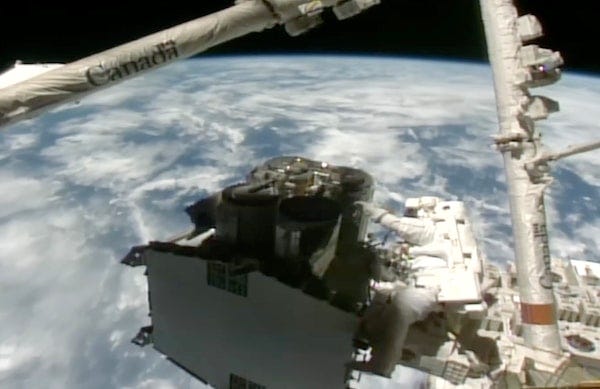
On Thursday, Canadian Space Agency astronaut Josh Kutryk and NASA astronaut Anil Menon spent 7 hours installing a new solar array. Kutryk is the fifth Canadian to spacewalk and the first since David Saint-Jacques in 2019.

Prepare for all contingencies
If announcements are a form of governance, then this past week made Canada the most governed nation on Earth.
On Monday came the historic First Nations–First Ministers meeting, the first in two decades, which opened talks on a First Nations sovereign wealth fund. Tuesday brought a new strategic partnership with the UAE, to go along with the one signed with Türkiye the week before. But Thursday is when Mark Carney really flooded the zone, with Canada’s first national security strategy in more than 20 years and a stake of up to $1.6 billion in Cohere. The PM closed the week with a Euro-palooza in Montreal, where he and Ursula von der Leyen launched an Alliance for the Future to deliver “greater affordability, opportunity, and sovereignty.”
Is there a method to the madness? Or is the prime minister just kicking up a lot of sand and hoping nobody can see the stagnating GDP, the shrinking payrolls, and the deficit numbers coming in next week’s budget?
If there is a through-line here, it is found in a single bullet of the security strategy, which commits Ottawa to “prepare for all contingencies up to and including war and other worst-case scenarios.” The Carney government has adopted a prepper mentality: when SHTF (i.e. the poop hits the fan), the ones who come through are the ones who are best prepared.
Read the security strategy that way and the resemblance to prepper doctrine is uncanny. Its premise is the prepper’s founding insight: the system you relied on will not be there when you need it. Geography, deep integration with other economies and a rules-based order, the document says, can no longer stand in for Canada’s own capacity to protect itself. Our old strengths have become vulnerabilities.
What follows is a typical prepper’s checklist. The strategy names eight “strategic capabilities” where Canada must be able to fend for itself: emerging technologies, critical minerals, defence, energy, transportation, pharmaceuticals, food, and payments. Water, generator, canned goods, first-aid kit, cash in the coffee can.
Every serious prepper also knows that going it alone is a fantasy. You need a network of neighbours with complementary skills and supplies and, crucially, a shared worldview. That is the Alliance for the Future. Canada is to become the EU’s first “associate member,” a status even von der Leyen calls uncharted territory.
Look at what was actually delivered in Montreal and the prepper logic is unmistakable. A $44-million contract for Montreal-made military helmets for Latvia. Up to $2.5 billion in financing for De Havilland waterbombers. Access to European supercomputers, the Galileo navigation system and the IRIS² secure satellite network. Work toward a stockpile of critical raw materials, and a study of a transatlantic data cable to reduce “reliance on a single provider.”
That “single provider” goes to the polls on Tuesday. When associate membership was floated in September, Donald Trump called it a possible “hostile act” and threatened Europe with heavy tariffs if it went ahead. Canada-U.S. trade talks have reportedly revived ahead of the midterms, but a Canadian official told Reuters this week that progress has been limited, and analysts warn the tariffs may well survive a Democratic Congress. Hedging against Washington is not paranoia, it is prudence.
The trouble with prepping though is that it means stockpiling things, just in case. This week, on top of the De Havilland money, Ottawa committed up to $1.6 billion for an equity stake in Cohere, a company that, as Build Canada CEO Lucy Hargreaves pointed out, is not short of capital, on terms that have not been disclosed. As Hargreaves put it, the government is becoming the owner, the funder, the customer and the regulator of the same companies. This is bunker economics, and it is a strategy for survival, not flourishing.
Meanwhile, the economy is stalling. Real GDP was flat in August for a second straight month, the flash estimate for September shows a slight contraction, and third-quarter growth is tracking at 1.3 per cent, well under the Bank of Canada’s forecast. Payroll employment fell by nearly 50,000 in August.
None of this makes the prepping unwarranted. The world really is more dangerous, Washington really is an unreliable partner, and preparing for all contingencies is wise. But the most important strategic capability is not on the list of eight, though it underwrites all of them: wealth. A richer country can afford a bigger military, better intelligence and its own satellites. It attracts allies instead of courting them, and its best companies find investors without a Crown corporation in the cap table.
The strategy says it begins, deliberately, with economic security. But security and growth are not the same thing. Security is about protecting what you have. Growth is about making more of it, and that mostly requires governments to clear the way: faster approvals, competitive taxes, a proper internal market, and firms that scale and stay here because Canada is the best place to build, not because Ottawa bought in.
Next Thursday’s budget will be the first big test of whether the prepper government is ready to come out of the bunker.
It’s a wrap! Fall 2026 Events Circuit


On Wednesday evening, 150+ entrepreneurs and policymakers made it out for an evening of conversation on how to build a bolder nation.
With it marks the end of our fall 2026 events circuit. We’re grateful to the 500+ Canadians who made their way out to our events in either Toronto, Montreal, or Ottawa.
Winter’s 2027 events schedule will land soon… where will we see you next?
Embrace the dark
This piece is written by Brendan Samek, Build Canada’s Head of Engineering, who lives in Edmonton.
In Canada’s North, there are two seasons. There is the season of the sun, a time of endless summer evenings, when kids feel like they are plants, powered by the barely setting sun, and where the stars meld into the orange-tinted night sky of summer.
But those days are in the past, and the season of darkness is upon us. In Edmonton, Canada’s northernmost metropolis, your author is preparing himself for its depths. On the longest day of the year, the sun will rise in Edmonton at 9:48 am, long past the time most northerners have shuffled their sleepy selves to school or to work. And in the evening, as they hurry home to their families, they might arrive just in time to see the sun set at 5:16 pm before being plunged into darkness anew.
As for the Canadians in the actual North, in the farthest reaches of our Dominion, their lot is even more extreme. In Yellowknife, at the peak of darkness, the sun will rise at 11:06 am and set at 4:04 pm. They may spend an entire day at work and never see the sun at all. And, along the Arctic Ocean, in Tuktoyaktuk? On December 21st, these Canadians will have been in darkness since November 28th; they will have to wait another 20 days before they see the sun again on January 14th for a total of 47 sunless days.
Meanwhile, Canada’s southerners, huddled so tightly by the border, with their four “seasons”, will have a much different experience. In Toronto, Canadians will experience a mild variation on the same monotony as they do the rest of the year: the sun will rise before the work day begins at 7:50 am and they will see the sun set on their way home at 4:50 pm.
I pity all of Canada’s southerners who will be missing something profound about the Canadian experience: the opportunity to become so enraptured by the stars on a still, moonless, late afternoon on a Tuesday while walking back home, that every fibre of your being pulls you to lie down on a pillow of snow with your gaze towards towards the heavens and to stop, completely. and to be one with the universe. Without any noises to distract you, and a burning cold in your throat as you breathe the frigid air to focus your attention on the most beautiful star-filled sky with a streak of milk right through the middle.
To embrace the dark is to embrace Canada.
— Brendan Samek
ICYMI: Lucy on the Paul Wells Podcast
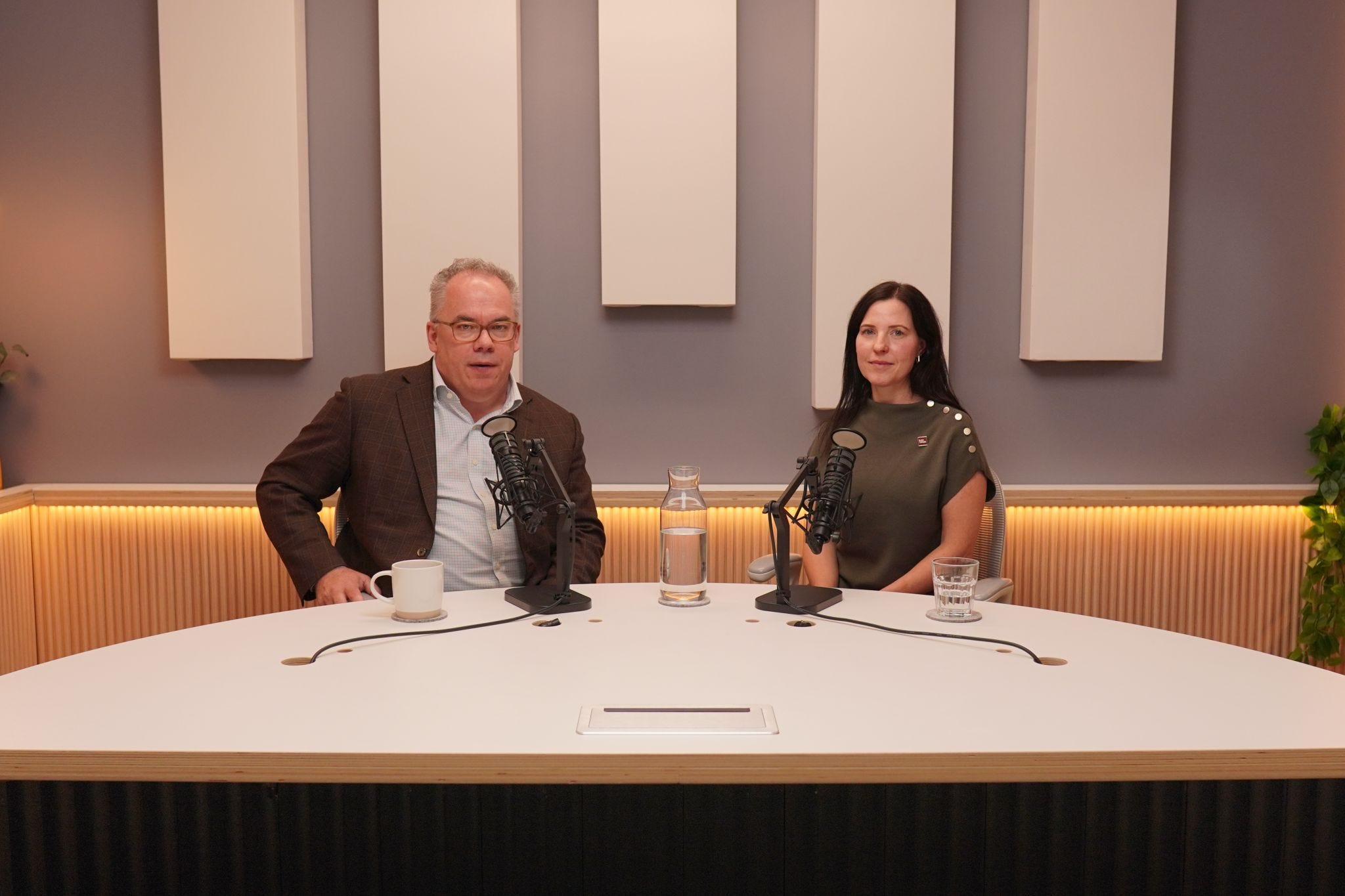
Lucy sat down with Paul Wells this week to talk all things Build Canada. Don’t miss it: the full episode is now available on all streaming platforms.
This week in building Canada
Oct 31 Alphonse Desjardins, the co-founder of the Caisses Populaires Desjardins, died on this day in 1920. At his death, some 140 credit unions were active in Quebec.
Nov 1 Construction began on the Confederation Bridge on this day in 1993. Work ran to May 1997 and cost C$1.3 billion. The span is Canada’s longest bridge.
Nov 2 Louis Riel took Upper Fort Garry in 1869. Métis forces turned back Lieutenant-Governor designate McDougall’s party near the U.S. border. The same day, Riel’s men seized Fort Garry without bloodshed.
Nov 3 Lower Canada had no reliable currency, so nine Montreal merchants pooled their money to create the Montreal Bank, which opened on November 3, 1817 on St. Paul Street. That makes it Canada’s oldest bank, and is why its institution number is 001.
Nov 4 Accommodation became the first steamboat to sail the St. Lawrence river, completed its maiden voyage and arrived in Quebec City on this day in 1809.
Nov 5 Sir John A. Macdonald resigned over the Pacific Scandal on this day in 1873, after defections undid his working majority. He came back five years later and governed for another 18 years.
Nov 6 Happy birthday to James Naismith, inventor of basketball, born in Ramsay Township, Ontario, in 1861.
Betty Goodwin (1923-2008)
Carbon (1987)

Betty Goodwin was one of Canada’s most influential contemporary multidisciplinary artists. Born in Montreal, she launched her career in painting and printmaking, gaining international acclaim in the late 1960s with her innovative Vest series, where she pressed everyday articles of clothing directly into soft-ground etchings to capture physical imprints of human presence.
Goodwin later expanded into sculpture, assemblage, and large-scale drawings. Her celebrated 1980s Swimmers series used charcoal, graphite, and oil pastels on translucent Mylar to depict suspended, floating, or sinking bodies, capturing grief and physical frailty. Over a prolific career, she represented Canada at the 1995 Venice Biennale and received prestigious honours, including the Prix Paul-Émile Borduas and appointment as an Officer of the Order of Canada.
News and noted
A new non-partisan Prime Ministers Institute will be committed to telling the stories of Canada through the lens of its prime ministers, from Sir John A. Macdonald to Mark Carney and those who succeed him.
A new Alberta bill will put a stop to DEI hiring. And Manitoba premier Wab Kinew is calling on Ottawa to abolish the Indian Act.
A new poll on immigration from the Environics Institute finds that first-generation Canadians and non-white Canadians have stronger opinions against immigration than white Canadians and third-generation+ Canadians. And a new report from the C.D. Howe Institute finds that immigrants in Canada score lower, on average, than non-immigrants on measures of literacy, numeracy, and adaptive problem-solving, with the largest gap in literacy.
This week saw the publication of Earthrise: A Canadian Astronaut’s Journey Into Deep Space, a collaboration between John Larsen and Jeremy Hansen that is billed as a “dramatic account” of Artemis II, the first deep space mission in 50 years.
According to a report funded by the government of South Korea, paper straws are far worse for the environment and for human health than plastic straws.
Get weekly, no-fluff insights on building a more prosperous Canada. Tap “Subscribe” now and be first in line for next week’s brief. Then forward this email to one friend who cares as much as you do—let’s build together.
It sure is funny though how he 'owned' Brexit now look at Britain. Now its Eu-Can-do will we be better off who knows, if we take on more debt probably not yet our dollar is forecasted to hit 60 cents next year. Time will tell I guess if it means more trade, then again we have to build quality stuff cheaper than they can but they are hit by high energy prices-darn russia-china collaborations and the proposed gas pipeline. Russia vs EU, EU needs cheap energy too. China vs Taiwan goodbye AI boom if that ever goes on. Trump vs the world he got Venezuela and greenland too (put a base on it own it, trying to mingle and meddle in south america too). The artic is next as china-russia-usa battle it out.