
Space is the Place
Canada in space. Carney in China. Legault on the outs. How to build Canada's business future. And new year, new events.
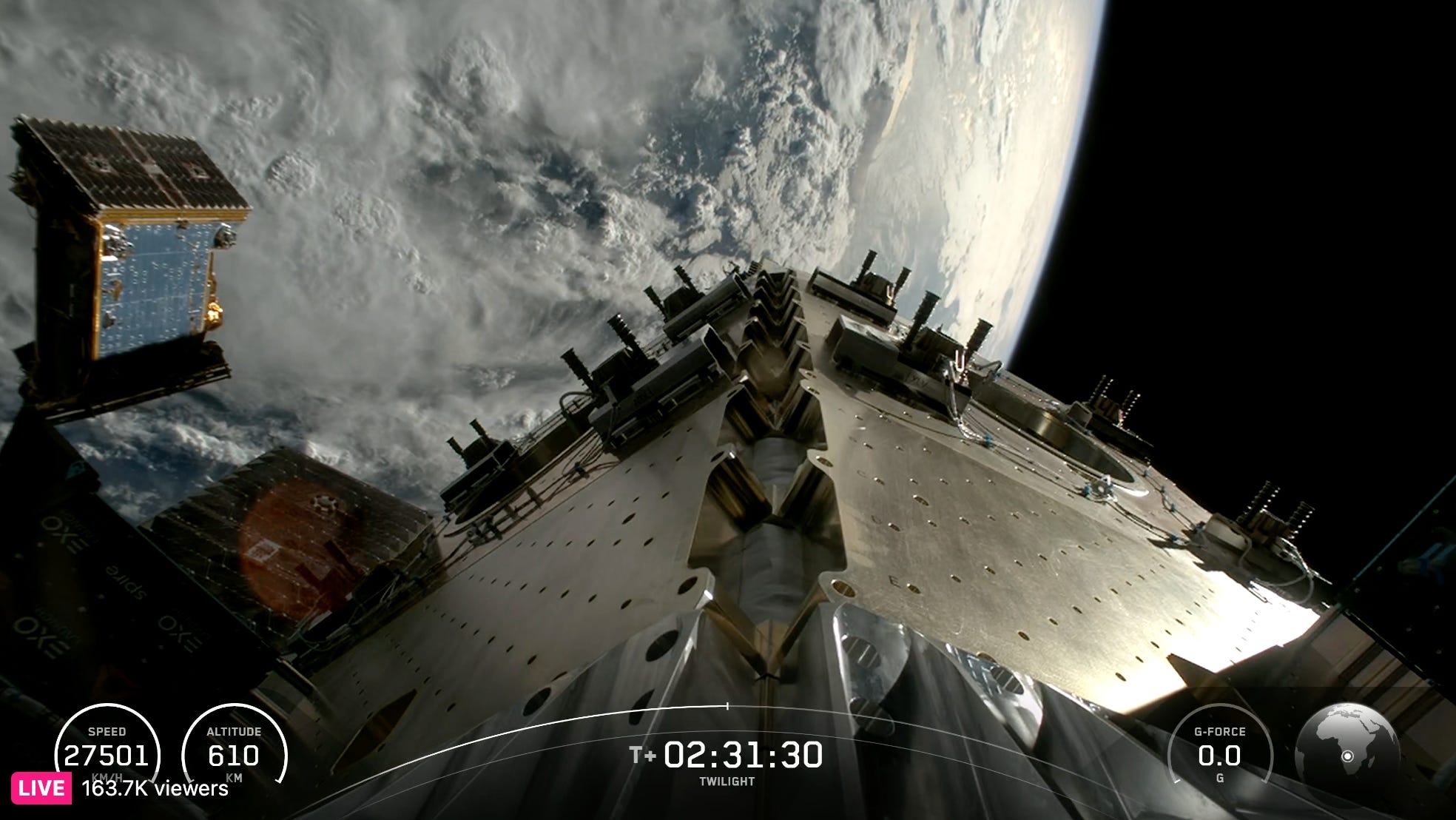
The week began on a high note – literally – with the successful launch last Sunday of ten Kepler Communications satellites aboard a SpaceX rocket. Kepler’s satellites are the first tranche toward building an optical data relay network, using laser-based communications to move data between satellites and down to Earth far faster and with much lower latency. In effect, they are building a kind of orbital internet backbone. As Mina Mitry, Kepler’s founder and CEO, put it in announcing the launch, this network is about “building the connective tissue that allows space systems to operate at the speed the modern world demands.”
It is also, quietly but unmistakably, about sovereignty. Canada has world-class space talent, but we have long been content to plug that talent into foreign systems. Kepler’s success suggests a different model: Canadian firms owning and operating essential pieces of space infrastructure, serving global customers from a Canadian base.
That ambition aligns with a broader effort to rebuild domestic space capabilities across the country. NordSpace, based in Ontario, is working toward launching Canadian-built rockets from Newfoundland, taking advantage of geography that allows safe launch corridors over the Atlantic. Further down the coast, Maritime Launch Services continues its long campaign to establish a commercial spaceport near Canso, Nova Scotia. And on Friday, a new rocket startup (called, magnificently, Canada Rocket Company) announced plans to soon become the first Canadian company to have the capacity to launch medium-payload satellites in space.
There is a lot of work to be done before we see Canadian satellites being launched on Canadian rockets from Canadian soil. But Kepler’s success shows what Canadian ambition looks like when it is paired with execution. Space is cool, but it is also tough. Canada is finally starting to look like a country prepared to do the hard parts.

Eastern Approaches
Prime Minister Mark Carney was in Beijing for a four-day trip this week, the first such visit by a Canadian prime minister since 2017. The big news, announced late Thursday evening, was that the two countries had struck a preliminary trade agreement as part of a broader effort to reset bilateral ties after years of disputes and retaliation. The centrepiece of the agreement is that Canada will allow almost 50,000 Chinese-made electric vehicles at a tariff rate of 6.1 per cent (down from 100 per cent), in return for China making large reductions in their own tariffs on Canadian canola seed and other agricultural products.
The deal has generated an enormous amount of political controversy over its strategic implications. Is it a foolish break with the United States, on the eve of the scheduled renegotiation of USMCA? A necessary diversification of Canada’s trading relationships? A predictable return to Liberal coziness with Beijing? A much-needed thawing of a relationship that was too long on ice? You are welcome to take your pick of how to interpret what Canada has agreed to.
But one thing that cannot be avoided are the domestic considerations that are in play. As is often the case in Canada, to figure what is going on, it helps to look at who is happy, and who is complaining.
In this case, Saskatchewan premier Scott Moe is happy, Manitoba premier Wab Kinew slightly less so, and Ontario premier Doug Ford is decidedly not. Moe (who, notably, accompanied Carney to Beijing), hailed the deal as “very good news” for prairie farmers while Ford slammed the decision to allow Chinese EVs into Canada, calling the deal “lopsided” while worrying about its ultimate impact on the Ontario, automobile industry.
There is no question that Canada was in a bind. We had imposed steep tariffs on Chinese EVs in lockstep with the U.S., which led to the retaliatory tariffs on Canadian agricultural products by Beijing. And the Chinese aren’t stupid, they know where Canada’s pressure points are: supporting domestic automakers at the expense of domestic farmers was for all intents a decision to favour Ontario’s interests over those of the prairie provinces.
And in a country already suffering from a serious flareup of Western alienation, it looks like the pain was starting to become too much for Carney.
Bits ‘n Bites
It was a pretty crazy week for Build Canada related news. After promising before Christmas that he would lead his party into the coming fall election, Quebec Premier François Legault announced his resignation on Wednesday (oddly, Ontario Liberal leader Bonnie Crombie also resigned on Wednesday, to much less fanfare). Anyway, faced with fresh polls showing that his party was almost certain to be annihilated, with pressure from his caucus growing, Legault bowed to the inevitable. His party now has just a few months to select a new leader before getting into campaign mode.
Meanwhile, the expected flood of staffing and spending cuts to the federal public service has started to flow, with Statistics Canada and Shared Services Canada issuing notices this week. In total, about 16,000 jobs are at stake, with the executive ranks being thinned by 12 per cent. While the government expects a big chunk of those to be taken up through buyouts or early retirement offers, there’s been a snag. As Kathryn May explains in her newsletter about the public service, the $1.5 billion allocated for buyouts hasn’t been approved yet, and is not expected to be until March at the earliest. Instead, managers have to send out affected letters to the maximum number of people because they don’t have a sense of how many buyouts they will get. As May quotes one senior bureaucrat: “They’ve created maximum anxiety, stressed the largest part of the department possible — all because of a timing problem.”
What’s new at Build Canada
Build Canada’s Business Future
A new memo from Kim G C Moody
Companies are not investing enough in Canada and the current federal approach of offering subsidies to individual companies, one deal at a time, to bribe them to set up offices and factories cannot reverse this trend. Instead of chasing companies with cheques or picking winners and losers, Canada must build a business environment that attracts them naturally.
The single most powerful lever to resolve this situation is corporate tax reform. Research spanning more than half a century has confirmed repeatedly that corporate taxes are the most harmful tax type for growth and in particular for company formation and investment. It is not a coincidence that company investments have shrunk since the US made its corporate tax regime more competitive compared to Canada in 2017.
If Canada acts creatively to reform corporate tax to only tax profits taken out of a business rather than profits that are reinvested it could change the environment for company formation and investment overnight. Read our latest memo here.
New Year, More Events

Featured event: What’s Next for Canada? Hamilton (link)
Our Chapters across the country wasted no time getting January events organized. Here are the next two weeks of Build Canada events and if you’re looking to see even deeper into the future, check out our full events calendar here.
Waterloo Chapter Kickoff (Jan 21): Waterloo, you would not stop asking for this so let’s get it started. Join your neighbours as we get started with Build Canada in your city.
Vancouver Reading Group – Housing Edition (Jan 21): Housing may be one of our most complex issues for Canadian cities. Join the Vancouver Chapter as they unpack what’s happening in Vancouver specifically and seek solutions.
What’s Next for Canada? Hamilton (Jan 22): Join your neighbours as we discuss what Canada must do to thrive in this increasingly complex geopolitical environment with David Lohse, CEO of the International Test Pilots School.
ConUHacks & the Montreal Meet Up (Jan 24): Build Canada is proud to sponsor Canada’s largest university hackathon and host an evening activity alongside it. The event is booking quickly – don’t miss your chance to be there!
What’s Next for Canada? Calgary (Jan 29): Unpack the complications of the changing world and understand how Canada can thrive in this environment in this special event.
And finally, you can’t go anywhere in Western Canada without bumping into something with Jim Pattison’s name on it, but what is amazing is just how much of an impact he’s had on the entire country. He had a few chances to run for office, but always declined, something he might slightly regret. Regardless, one of the hardest working men in the country is this week’s Great Canadian Builder.
How Flin Flon got its name
Before there were Heritage Minutes the NFB had Canada Vignettes, mostly animated shorts about random bits of Canadian heritage. This one explains how Flin Flon became the only Canadian town named after a science fiction hero.
What else we’ve been reading
Ken Whyte argues that we have become what Margaret Atwood feared — a nation of cultural morons.
One of our new favourite newsletters is Bryan Danielson’s Not Sorry, devoted to championing Canadian ambition.
Ottawa wouldn’t do it, so Artist Sarah Lazarovic started her own national portrait gallery.
There’s a new round of auctions for HBC blankets, art and other stuff.
Writing in the National Post, Chris Dummitt makes the case for the redemption of Sir John A Macdonald.
Construction on the Toronto-Quebec City part of the high speed rail system won’t start until 2032, the CEO says.
Get weekly, no-fluff insights on building a more prosperous Canada. Tap “Subscribe” now and be first in line for next week’s brief. Then forward this email to one friend who cares as much as you do—let’s build together.
The Kepler success is massive but what's interesting is the timing with Canadian ambition finally catching up. For years we've had the talent but were comfortable being subcontractors instead of prime operators. I remeber when Nortel collapsed everyone said Canada couldnt compete at infrastructure scale anymore. The shift from supporting foreign systems to actually owning critical orbital backbone is the kind of sovereignty move that changes everything downstream.
Thank you for an insightful article, while I am wearing my “Build Canada” t-shirt! Two questions come to mind. One is, it is hard to support various parts of the country in trade negotiations regarding “winners and losers”. For example, reduced canola tariffs and limited market access to Chinese EV’s. The 75,000 farmers are relieved somewhat and Premiere Doug Ford is very unhappy. It brings to mind how many billions of dollars or similar allowances over the years have been provided to auto makers by all levels of government.
Another factor regarding tax restructuring, I am hardly an expert. It is heartening to see various government agencies provide seed money to Canadian businesses. I believe a point from your last post recommended not taxing companies for reinvesting their profits into company expansion. I hope I got that right and I hope such tax reform occurs.