


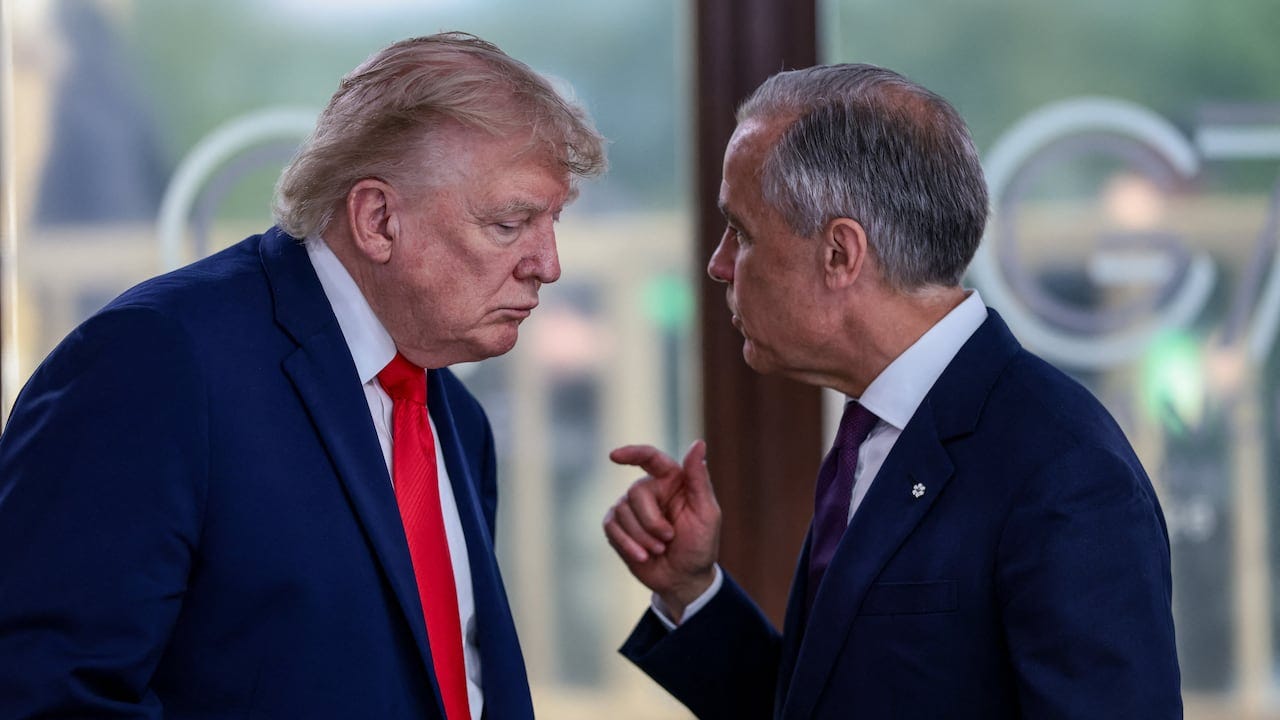
U.S. President Donald Trump andd Prime Minister Mark Carney in Evian-les-Bains, France this passing June. (Photo: Evelyn Hockstein of Reuters)

A Bump in a Centuries Old Relationship
In September 1911, Wilfrid Laurier put the best trade deal Canada had been offered in a generation in front of voters. Washington had agreed to open its market to Canadian farm goods, fish, and lumber, terms Ottawa had chased for four decades. It should have been a coronation.
But then the Americans started talking. President Taft mused that Canada had reached a “parting of the ways.” Champ Clark, Speaker of the House, said he backed the deal because “I hope to see the day when the American flag will float over every square foot of the British North American possessions, clear to the North Pole.”
Canadian manufacturers, who liked their tariff wall just fine, could not have scripted it better. The Conservatives campaigned on one slogan, “No truck nor trade with the Yankees”, and won 133 seats to Laurier’s 85. The deal died and Laurier’s fifteen years as prime minister died with it.
If any of this sounds familiar… that’s the point.
This morning, Canada woke up to news that there was no deal with the United States, with Canada claiming that the U.S. made “last-minute changes in the proposed terms [that] were unfair”, and the U.S. claiming that Canada made “new demands and walk backs of other commitments”. While the public doesn’t yet have the full details of what actually transpired, we do know the history, and the history can be instructive.
Canada and the United States have been signing, tearing up, and re-signing trade agreements since before Canada was a country. The Reciprocity Treaty of 1854 gave the British North American colonies free trade in natural resources with the US. Washington ripped it up in 1866. Little more than a year later, the colonies – suddenly cut off from their biggest market – confederated. It is only a slight exaggeration to say a cancelled trade deal helped create Canada.
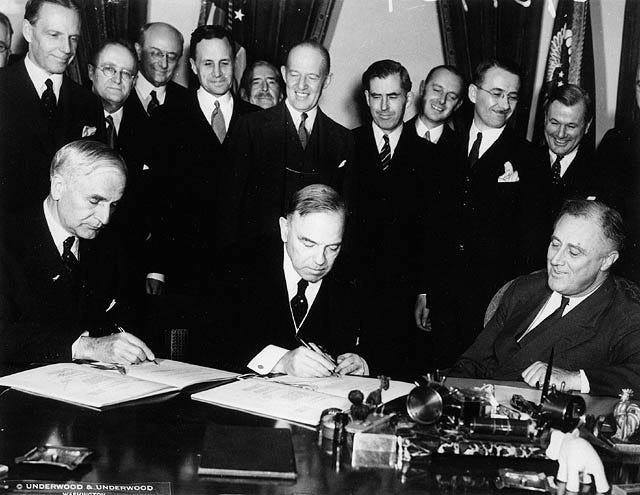
Washington, November 15, 1935. Mackenzie King and Franklin Roosevelt sign the first Canada–U.S. trade agreement since 1854 — ending a five-year tariff war that deepened the Depression on both sides of the border. From Library and Archives Canada

Canada answered with the National Policy in 1879: a tariff wall of our own, meant to force a manufacturing economy into existence. It protected some industries. It also gave Canadians decades of higher prices and watched hundreds of thousands of them move south for opportunity. Protection has costs. It always has.
The pendulum swung back over time. The 1965 Auto Pact integrated the two countries’ auto industries and turned southern Ontario into a manufacturing powerhouse. And in 1988, free trade finally won the election it had lost in 1911.
The stakes in 1988 could not have been higher, with an election fought on a single question. John Turner called it “the fight of my life.” In the televised debate he told Mulroney, “I happen to believe that you’ve sold us out”; that with “one signature of a pen” Canada would be reduced to “a colony of the United States.” The same annexation fears that destroyed the 1911 deal filled the airwaves: free trade would erase the border, then the country.
Voter turnout hit levels we haven’t seen since. If Mulroney had lost, the agreement would have died, and Canada’s economic course changed for a generation. But he won. The deal survived. NAFTA followed, and with it the deepest trading relationship on earth: roughly $3.6 billion in goods and services crossing the border every single day.
Here is what 170 years of this teaches:
The Canada - U.S. relationship keeps getting renegotiated, and it keeps surviving. 1866, 1911, 1971, 1988, 2018, and now 2026. Every generation or two, the terms get torn up. Every time, a new arrangement emerges because geography, supply chains, and mutual gain are more durable than any politician’s mood.
Trade with the U.S. has made both countries richer. Two-way trade more than tripled after the 1988 agreement took effect. It now runs at roughly US$900 billion a year. Canada is the number one export market for more American states than any other country. Canadian energy powers American industry. Canadian aluminum and lumber build American homes. American capital and markets help scale Canadian companies. Eight million American jobs depend on it, and one in seven Canadian jobs does too. This is not a relationship where only one side wins.
As in any negotiation, the terms we get abroad reflect the strength we build at home. This is the lesson Canadians keep relearning. The countries that negotiate well are the ones with options, with productive economies, competitive industries, and trading relationships beyond one border.
In the coming days, we will likely see it all laid out in front of us. What was really on the table, what happened in the final hours of the negotiation, and was walking away and escalating a trade war the right move for Canada?
The bigger questions are still the ones we set out when this latest trade dispute began: how can Canada be more sovereign, more united, and more prosperous over the long term?
In 1911, Canadians rejected a deal out of fear. In 1988, they accepted one out of confidence. The difference between those two countries wasn’t the deal on offer. It was how much they believed in what they could build. How much they believed that they could be the masters of their own destiny.
Stay Informed…
Build Canada will be providing comprehensive coverage and insight into all aspects of the USCAN deal.
We will continue to champion the truth that our nations stand most powerful when they cooperate, and that this temporary rift must be used as an opportunity to strengthen Canada. 🇨🇦🇺🇸


Our lovely newsletter author, Andrew Potter, is off on a well earned vacation. Enjoy this special writing by Lucy Hargreaves, CEO & Co-Founder here at Build Canada.
I trust Carney did what was in our best interest. Full stop.
Thank you for the history refresher. I think that Canadians prefer to go through the transition to find new markets for what is imported by the US, leaving 15-20% in this export market, because the unsavoury US administration people are lost in their arrogance. Why negotiate when the other side insists on colonizing our country? The actions of those is the US administration’s positions of power, have presented clearly their intentions. Yes, they will do their best to punish Canada. We must realize this fact, as well as learn how to prosper through intelligent economic & social choices. I find PM Carney’s guidance is invaluable for the reorganization required for Canada to hit its potential.