

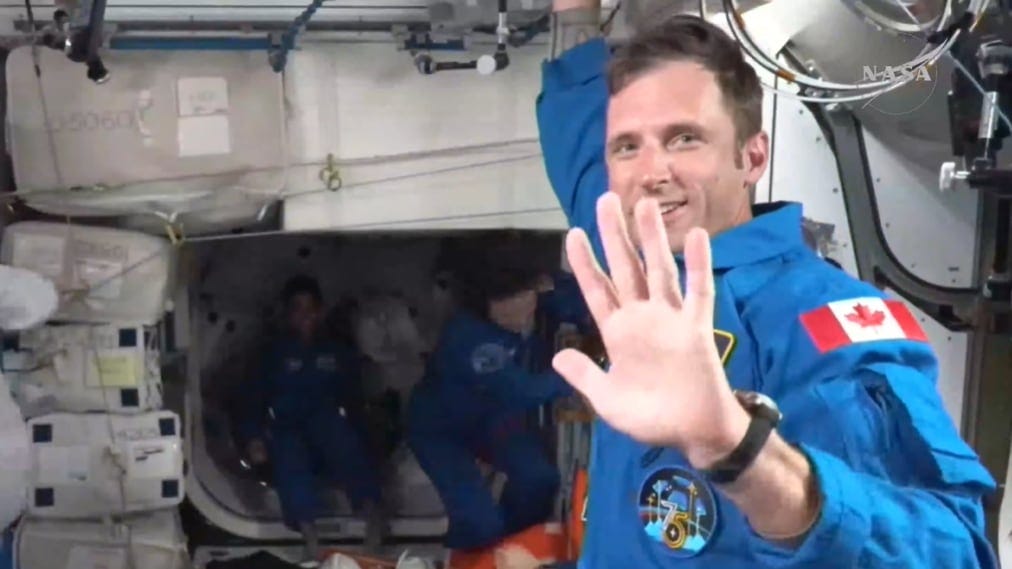
Canadian Space Agency astronaut Joshua Kutryk successfully launched on October 1 aboard the SpaceX Crew Dragon spacecraft for a six-month mission to the International Space Station (ISS). Also on Thursday, a SpaceX Falcon 9 rocket on the launched three Canadian satellites from California, including two methane monitors for GHGSat and the first satellite built by NordSpace.

Check against delivery
Prime Minister Mark Carney went to Fort McMurray on Thursday to announce that a proposed one million barrel a day oil pipeline from Alberta to the B.C. coast has been designated as a project of national interest under the Building Canada Act. In response, former Alberta premier Jason Kenney took to X to celebrate. He wrote:
Take a bow, Alberta WE WON!!! 👏🏼👏🏼👏🏼
Every line of this is what we Albertans have been saying for years!
Total repudiation of the Trudeau-Guilbault [sic] energy policy!
“Global oil demand will remain in the tens of millions of barrels a day for decades to come.
“So the question is: who will be the world’s trusted supplier of oil for years to come. It should be us. It must be Canada.”
There is a lot to unpack here. There is the question of what the “project of national interest” decision means at face value for the oil patch and for resource development in Canada more generally. There is the implication of what it might mean for national unity. But even beyond that, it is worth looking at the speech Carney was expected to give compared with the one he actually delivered. Because in there we can find signs of where the prime minister is looking to take the country.
Let’s start with the “we won” line, and Kenney’s claim that this marks a “total repudiation” of Trudeau’s energy policy.
On the substance, he has a point. Speaking after Carney, Alberta Premier Danielle Smith read from her old list of grievances against Trudeau that have since been scrapped, suspended or gutted: the oil sands emissions cap, the clean electricity regulations, the EV mandate, and now a rewrite of the impact assessment regime.
Yet Carney can perhaps be forgiven for not actually throwing his predecessor under the excavator. Instead, he took note of a “well-intentioned, but arduous” regulatory regime, naming the process, not specific people, as the villain in this story. Also, while Kenney doesn’t mention it, Carney is still trying to cram his new pipeline advocacy into the old climate framework. We face an energy crisis, Carney said, naming its three dimensions: affordability, energy security, but also the existential threat of climate change.
Finally, the pipeline is paired with a carbon capture project, routed south along an existing corridor to spare the northern B.C. coast, and folded into an ocean protection plan announced this week. If this is repudiation, it is more in deeds than in words.
It is also worth noting that the national interest designation is not an approval. Opposition leader Pierre Poilievre’s take — ‘Wake me up when there’s a steel pipe going in the dirt” — struck some as excessively churlish, but as Rob Breakenridge reminds us in the National Post, even the best case scenario is another year to final approval and five more till oil is flowing. Meanwhile, Carney’s previous commitment, that without a private-sector proponent there would be no pipeline, survives on a narrow technicality: Pembina is an investor, but Ottawa and Alberta each hold half, a Crown corporation leads development, and Ottawa is spending $10 billion expanding capacity at Roberts Bank.
With respect to national unity, Carney’s closing theme is about building “together what we could not build alone,” and it is a happy coincidence that this is all happening less than three weeks before Alberta’s October 19 referendum. While it probably won’t move the die-hard separatists, federal backing of a pipeline is just about the best news the Remain side could have asked for.
Which brings us to two speeches. Paul Wells published the text that was circulated in advance, and the Prime Minister’s Office has since posted what appears to be the version as delivered. Political speeches are always re-written on the fly and there’s a reason it is always important to check against delivery. Nevertheless, the changes are informative.
“It must be Canada,” the line Kenney embraced, is not in the prepared text, which simply reads “It should be us.” In the Wells text, the pipeline’s carbon capture project, Pathways, is named as a “prerequisite for the pipeline”; in the delivered text the word prerequisite is gone. Instead, Carney simply said “Canada, the Government of Alberta, and the Oil Sands Alliance will advance construction of the Pathways Project.”
There are other changes; “Tens of thousands of good jobs” became “tens, in fact, hundreds of thousands.” And the prepared ending about what “Canada” can achieve became what “Alberta and Canada” can achieve, with a sign-off that puts Alberta first.
There is one last thing worth noting about Kenney’s tweet, and that is his claim that “WE WON!!!”. That implies somebody lost, and it is not obvious here who that might be. The best candidate is an idea: that the oil patch is a problem for Ottawa to manage rather than a generational asset for the country to build on.
On Thursday, Carney spoke about Fort McMurray and the oil sands the way Canadians used to speak of the Seaway or the CPR: as something extraordinary that Canadians built together, and he invited us to do it again. Tony Keller wrote in the Globe this week that this is a sign that Canada is finally acting like a normal country. It says something about how far we had drifted that normal should sound so ambitious.
This week in Building Canada
Oct 3 On the afternoon of 3 October 1914, 32 transports carrying about 33,000 troops assembled off Gaspé. It was the first contingent of Canadians to go off to fight in the Great War, reaching Plymouth eleven days later.
Oct 4 Pianist Glenn Gould passed away on this day in 1982, at the age of 50, after suffering a stroke a week earlier.
Oct 4 The first prototype of the Avro Arrow was rolled out on this day 1957, though the event was overshadowed by the launch of Sputnik the same day.
Oct 5 British diplomat James Cross was kidnapped on this day in 1970 by the FLQ, kicking off the “October crisis”. Also on October 5, the Space Shuttle Challenger launched, carrying payload specialist Marc Garneau as the first Canadian in space
Oct 6 The Confederation Centre of the Arts in Charlottetown was opened on this day in 1964 by Queen Elizabeth II.
Oct 7 On this day in 1763, the Royal Proclamation established the colony of Quebec. It also reserved land west of the Appalachians for Indigenous nations and barred settlers from buying Indigenous land.

Builder Minutes
In 1800s Toronto, nearly 50% of recorded deaths were children under 10. A women's Bible study group led by Elizabeth McMaster sought to change that. In a rented house with 6 iron cots & no running water, Canada’s first children's hospital was born.
Frances Anne Hopkins (1838-1919)
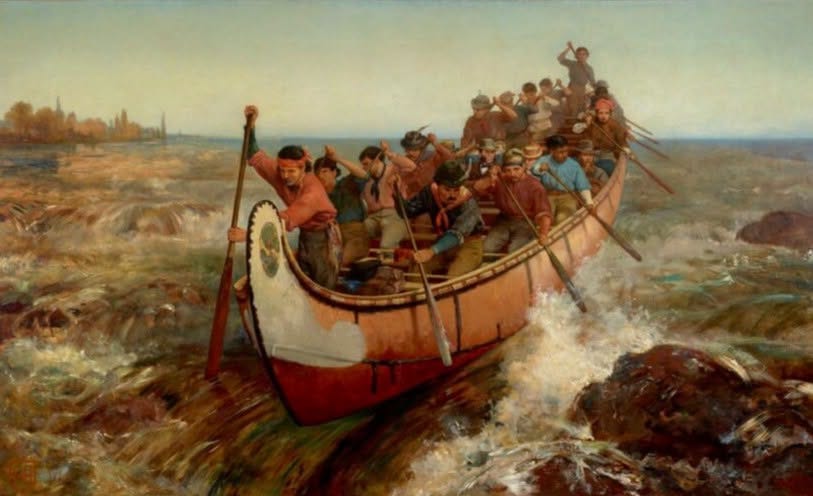
Frances Anne Hopkins (née Beechey) was born in England in 1838. After marrying Edward Hopkins of the Hudson’s Bay Company, she moved to Lachine, near Montreal, where her earliest known works depicted scenes near their home. In 1860 her husband was promoted to Chief Factor of Montreal, and the couple began joining voyageurs on journeys up the river, sometimes travelling by canoe all the way to Fort William, now Thunder Bay. The trips meant weeks of rough living alongside the paddlers.
While the voyageurs paddled or made camp, Hopkins sketched what she saw, documenting their lives as a photographer might. Most of her voyageur paintings were completed after she returned to London in 1870. In Shooting the Rapids (above) she included herself, her husband and two other passengers seated in the middle of the canoe.
Her paintings were praised for combining accuracy with artistic polish, and pieces such as Canoes in a Fog and Running a Rapid on the Mattawa River were shown at the Royal Academy. She captured a time when the fur trade was declining, and her work preserves a record of the final heyday of the voyageurs.
Get weekly, no-fluff insights on building a more prosperous Canada. Tap “Subscribe” now and be first in line for next week’s brief. Then forward this email to one friend who cares as much as you do—let’s build together.
I think the true Canadian "WE WON!" moment will be when the Northern Shield Energy Corridor exists from Hardisty to Sarnia. That will a truly Canadian project of National Interest from many perspectives.
> There is one last thing worth noting about Kenney’s tweet, and that is his claim that “WE WON!!!”. That implies somebody lost, and it is not obvious here who that might be.
I thought it was obvious that the “loser” here is the idea of rapid decarbonization with forced reduction of energy use, sometimes called “degrowth” or “Dark Green environmentalism”. There’s a reason many Alberta leaders call the previous policies the “Trudeau-Guilbeault” policies or even just the Guilbeault policies.