
Demolition by neglect
The grounding of the Snowbirds is the latest instalment in a long Liberal project of institutional vandalism.

There is a passage in Walter Bagehot’s essential 1867 book The English Constitution where he distinguishes between the “dignified” and the “efficient” parts of a constitutional order. The efficient parts do the actual work: Parliament, cabinet, the machinery of public administration. The dignified parts, the Crown above all, exist to inspire loyalty, to focus public reverence, to hold the emotional architecture of the nation together while the efficient parts get on with the frequently messy business of governing. Bagehot’s point is that a healthy polity needs both, where the dignified institutions act as a kind of psychic buffer, absorbing the friction that partisan politics generates while keeping the public broadly attached to the system as a whole.
Canada has always been a country thin on the ground when it comes to dignified institutions. The Crown, already one step removed from true royalty as represented by the Governor General, has for decades been treated by Liberal governments with a growing mix of negligence and condescension. The RCMP has been misused for years, deployed as a political instrument when convenient, starved of resources and leadership when not. The CBC has been allowed to drift into irrelevance and dependency in equal measure, its mandate wildly unfocused and its funding never quite sufficient to do the core job it has theoretically been assigned..
And then there is 24 Sussex Drive, the prime minister’s official residence, which has sat empty and deteriorating since 2015, its electrical systems a declared fire hazard, its plumbing failing on a regular basis, mould and asbestos throughout, costing taxpayers millions in basic upkeep while the government ran out the clock on successive promises of renovation.
The heritage community has a term for what happens when a building is allowed to decay through inaction rather than intent. They call it demolition by neglect. As a description of Liberal stewardship of our national symbolic heritage, it is hard to improve on. Justin Trudeau’s decision to order the Canadian flag to fly at half staff over federal buildings for the better part of a year — an act of national vandalism dressed up as mourning — remains only the most egregious single episode of this broad-based pattern.
Which brings us to the Snowbirds.
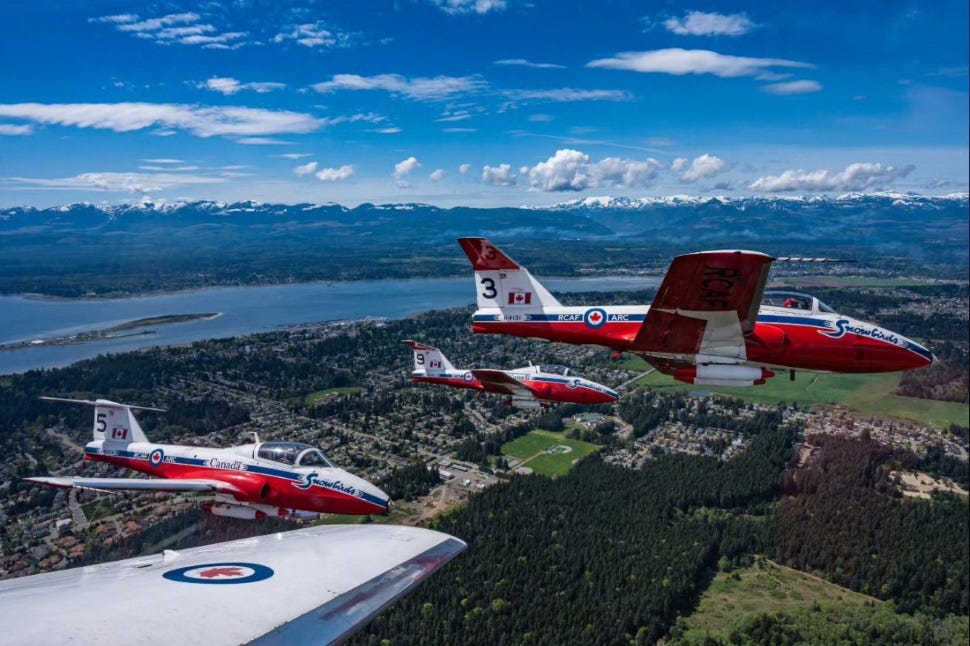
Last week, Defence Minister David McGuinty announced that Canada’s iconic 431 Air Demonstration Squadron will be grounded following the 2026 flying season until new aircraft arrive, with no firm timeline for when that might be. The CT-114 Tutor jets, which have been in RCAF inventory since 1963 and have served as the Snowbirds’ platform since 1971, will retire three years earlier than anticipated. The replacement, the government says, will be the Swiss-made CT-157 Siskin II, with new aircraft expected to become operational “sometime in the early 2030s.”
When it comes to the federal government, “the early 2030s” is basically a shrug emoji, a phrase that functions not as a firm commitment, but as an admission that there isn’t one. We are talking, at minimum, about a gap of six to eight years, but more than likely a full decade or more, during which the skies above the Peace Tower will be quiet on Canada Day, during which airshows from Abbotsford to Halifax will have to make do with foreign performers, during which one of the most effective recruitment tools the Canadian Armed Forces possesses will simply cease to exist. But more than anything, it is another thread snipped out from the already threadbare fabric that links Canadians to one another and to the country they share. In their time, the Snowbirds have performed over 2,700 air displays for more than 140 million people. That is the dignified part of the constitution doing its job.
There is also the matter of the planes themselves. The controversy over the choice of replacement aircraft has been somewhat lost in the shuffle of the announcement, but it deserves attention. The CT-157 Siskin II is a turboprop trainer, not a jet. “It wouldn’t have been our first choice,” said Dan Dempsey, secretary of the Snowbirds Alumni Association and former commanding officer of the performance fleet. “As a G7 nation, all the other G7 nations that are flying aerobatic teams are flying jet aircraft. Dempsey’s preferred solution would have been to reduce the number of aging jets in service until 2030 to keep the team flying and the pilots rehearsed. But it was apparently not seriously considered.
Mark Carney’s Liberals have shown occasional signs of understanding that neglect is just demolition by other means. The injection of $755 million into national sports organizations in the recent spending update was a tacit acknowledgement that twenty years of stagnant funding had led directly to the disappointments of Milan-Cortina. But there is precious little sign of a more general appreciation that Canada’s symbolic heritage isn’t self-sustaining, that it requires a strategic understanding of what parts need shoring up, which elements need a bit of extra love and attention.
Carney’s appointment of Louise Arbour as Canada’s next Governor General is instructive here. Arbour is, by any measure, a distinguished Canadian. She is also a choice so predictable, so perfectly calibrated to the ideals of the Laurentian professional class, that it could have been generated by a chatbot trained exclusively on Globe and Mail op-ed pages. There was clearly no serious canvassing of this vast country of 40 million, no clear-eyed examination of what that office could mean to Canadians under fifty, or who live outside the Montreal-Ottawa-Toronto corridor.
In trying to explain why the Snowbirds were being grounded, a clearly unhappy Carney came as close as he ever will to throwing his predecessor under the bus. And it is to his credit that he insisted McGuinty travel to Saskatchewan to make the announcement in person.
But it is hard not to wonder, in the end, whether things would look different for the Snowbirds, and for the country, if Dan Dempsey were a former Supreme Court Justice, or if 431 Squadron were based at CFB Bagotville rather than 15 Wing Moose Jaw.
— Andrew Potter
Last chance to see the Snowbirds: Here is their 2026 schedule.

This week in Building Canada
May 23: The North-West Mounted Police (NWMP) were officially created and established in Canadian law on this day in 1873.
May 24: Canadian women were given the right to vote in federal elections on this day in 1918.
May 25: The Royal Society of Canada was founded on this day in 1882.
May 27: Under Prime Minister William Lyon Mackenzie King, the Bank of Canada is nationalized on this day in 1938. It becomes a federal Crown corporation, as it remains today.
May 29: On this day in 1999, Julie Payette became the first Canadian to board the International Space Station as part of STS-96, the first shuttle docking of the ISS.
One year with the Snowbirds
A 2002 documentary by Mark Miller
New Memo: The AI Literacy Dividend
This week we sent the Standing Committee on Finance another pre-budget submission - this one on closing Canada’s AI adoption gap:
A Canadian AI Subscription Deduction that would give individuals a 100% tax deduction on up to $3,000/year for AI subscriptions, tools, and training.
A tiered AI Productivity Super-Deduction for businesses including 400% for CCPCs on up to $500K, and 200% for larger firms on up to $5M. The goal is to make the adoption decision a no-brainer.
And a built-in sunset clause that tapers both deductions once Canada cracks the OECD top three for business AI adoption.
Check it out! Canadian businesses currently report AI adoption at 12.2%, against an OECD average of 20.2%. We think the tax code is the right lever to close that gap.


Brian Jungen (1970-)
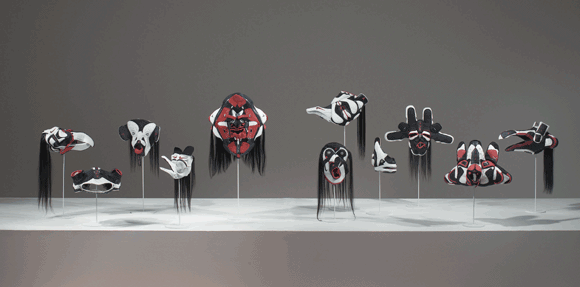
Brian Jungen was born on April 29, 1970, in Fort St. John, British Columbia. Of mixed Dane-Zaa First Nations and Swiss ancestry, he studied at Emily Carr College of Art and Design before emerging as one of the most internationally recognized Canadian artists of his generation.
Jungen’s breakthrough came with his Prototypes for New Understanding series (photo above), in which he disassembled Nike Air Jordan sneakers and reassembled them into objects resembling Northwest Coast First Nations ceremonial masks. The work is deceptively simple in concept, forcing a collision between global consumer culture and Indigenous artistic tradition. He extended this method across a wide range of materials: sports uniforms, plastic furniture, and other mass-produced goods were transformed into whale skeletons, totem-like forms, and large-scale installations.
Jungen won the inaugural Sobey Art Award in 2002 and the Gershon Iskowitz Prize in 2010, and was awarded the 2025 Audain Prize for the Visual Arts, one of Canada’s highest honours in the arts. He currently lives in a cabin at Moberly Lake in northern British Columbia, where he has turned toward public art and a new practice making arrows in wood and carbon fibre, which he fires into objects as both sculpture and performance.
What it will take to Build in Canada

Toronto Tech Week is upon us, and we’re looking forward to seeing thousands of you at events throughout the week!
In addition to our CEO, Lucy Hargreaves, speaking at Homecoming, we’re hosting our own event with Ada, What it will take to Build in Canada.
Tickets are officially sold out, but you can still tune into the event at 8pm ET on our X and YouTube.
What else we’ve been reading
De Havilland Canada broke ground on its new aircraft manufacturing facility outside Calgary last week. Marconi is back in Montreal as a military communications firm. And RIP Robert K. Irving, the co-CEO of J.D. Irving Ltd.
A new Canadian army division will be centred on armoured vehicles, mobile artillery and drone warfare. But meanwhile, the military is asking military personnel to return some field gear to address “critical equipment shortages”.
A panel appointed by the government of Newfoundland and Labrador has poured cold water on the deal that had been negotiated with Quebec to develop Churchill Falls.
The celebrations after the Canadiens won game seven of their quarter final series against Buffalo caused a small earthquake in Montreal, according to a McGill seismologist.
Canada’s History magazine (formerly known as The Beaver) has an in-depth feature on the history of the canoe, with big shoutouts to the Canoe Museum in Peterborough.
Get weekly, no-fluff insights on building a more prosperous Canada. Tap “Subscribe” now and be first in line for next week’s brief. Then forward this email to one friend who cares as much as you do—let’s build together.
Andrew, there has been zero studies on the recruitment effectiveness of the Snowbirds. It’s all anecdotal.
Also the RCAF has been trying to rid itself of the Snowbirds for years. It serves zero military purpose and the RCAF is too stretched as it is just doing its job.
The snowbirds came to Midland Ontario last summer and were a thrill to watch. However, I believe it’s time to ground these very old fuselages before something (god forbid) very bad happens.
These skilled pilots need new modern jets to fly that are not t
training aircraft. Let’s see a them fly a squadron of JAS 39 Gripens in formations at airshows across Canada.
That will make us proud!