
Eastern Approaches
Carney's pitch to middle powers. A report on the Maritime DISH. A housing event in Montreal. And don't forget to change your clocks!
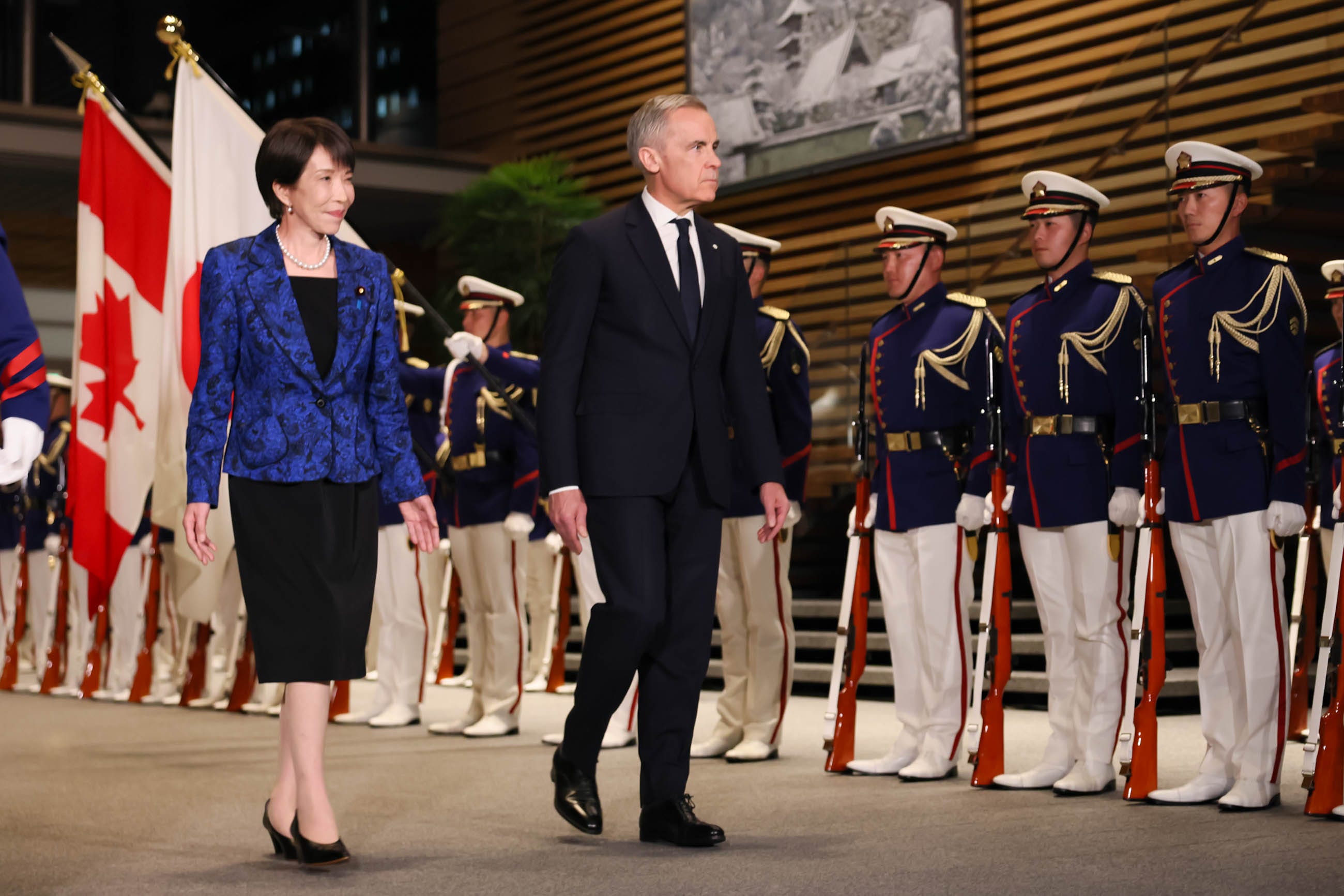
Prime Minister Mark Carney’s ten-day swing through the Indo-Pacific was less a traditional diplomatic tour than a demonstration project for his emerging foreign policy doctrine: that Canada’s future lies in tighter cooperation among “middle powers.” The question going in was whether the trip would produce concrete results or remain largely symbolic. The answer is somewhere in between.
The most tangible agreements came in India. Meeting with Prime Minister Narendra Modi in New Delhi, Carney helped secure more than $5 billion in commercial agreements and laid the groundwork for a broader reset of Canada–India relations. The centrepiece was a $2.6-billion uranium supply agreement between Saskatoon-based Cameco and India’s nuclear energy sector, alongside new memorandums on critical minerals and clean energy cooperation. The two countries also committed to completing a long-negotiated Comprehensive Economic Partnership Agreement this year, with the goal of doubling bilateral trade to $70 billion by 2030.
Notwithstanding the economic benefits, the bigger significance for Canada may be political. After several years of highly strained relations, the visit effectively marked a normalization of ties. For a government eager to diversify trade away from the United States, that matters.
Australia was, in some ways, the strategic centrepiece of the trip. Carney’s address to both houses of Parliament in Canberra — the first by a Canadian prime minister in nearly twenty years — had the quality of a manifesto. His line that middle powers can either “compete for favour or combine for strength” is the clearest articulation yet of what his foreign policy doctrine actually is. Albanese, who clearly agrees with that analysis, responded in kind. The substantive outcomes were solid: Australia joining Canada’s G7 Critical Minerals Production Alliance, a new MOU on AI safety, deepened defence cooperation including plans for Canadian Armed Forces personnel to train on Australia’s Arctic Over-the-Horizon Radar system, and a modernised tax and investment treaty. Together, Canada and Australia now control roughly a third of the world’s lithium, uranium, and iron ore. That’s not a talking point; that’s actual leverage.
The final leg in Tokyo delivered the tour’s most sweeping diplomatic announcement. Carney and Japanese Prime Minister Sanae Takaichi unveiled a new “Comprehensive Strategic Partnership” covering defence, energy, critical minerals, technology and advanced manufacturing. The agreement includes joint work on clean energy technologies, expanded defence cooperation and closer collaboration on semiconductor and AI supply chains.
Taken together, the deals add up to a fairly coherent strategy. Canada is positioning itself as a supplier of what the Indo-Pacific increasingly needs: energy, uranium, and critical minerals, along with expertise in clean technology and advanced research.
The hard part, of course, comes next. MOUs and strategic partnerships are not exports. The CEPA with India has been “almost done” before and collapsed under the weight of domestic political pressures on both sides. The middle-powers coalition is an idea in search of an institution. But after this tour, Carney has at least moved the ideas in his Davos speech to something approaching a coherent national strategy.

Spring Forward!
The clocks go forward this overnight Saturday in most of Canada, though in British Columbia it will be for the last time. The province announced last week it will move permanently to Daylight Time, with Alberta pondering whether to follow suit. Interestingly, while most people know that Great Canadian Builder Sir Sandford Fleming invented standard time, fewer are aware that the first implementation of Daylight Time was by Port Arthur and Fort William (later merged into Thunder Bay), in Ontario, in 1908.
Canadian Eyes Only
By: Melanie Nadeau
During the Second World War, Canada’s National Research Council, working with universities, private industry, and the military, played a critical role in developing and mass-producing radar technology. This work was done in secure facilities largely by the company that would later become Nortel.
The result was Night Watchman, the first operational radar system deployed anywhere in North America. It played a major role in Canada’s coastal defence, protecting against German warships and U-boats attempting to enter Halifax Harbour under cover of darkness and fog.
That effort helped launch Canada’s electronic components industry as well as Nortel, which at its peak employed tens of thousands of Canadians and represented over a third of the total capitalisation of the Toronto Stock Exchange. Nortel’s later decline had many causes, but persistent concerns about foreign access to its networks and intellectual property remain a cautionary lesson. Innovation without strong protection rarely remains domestic for long.
Prime Minister Mark Carney is right that the world has changed. Canada now needs to ensure that its systems change with it. The rules-based international order can no longer be assumed, and middle powers like Canada must recalibrate their relationships with the great powers if they are to protect prosperity and sovereignty in a more competitive world.
That realism, however, creates an immediate unresolved tension. Canada is investing historic sums in defence, Arctic security and dual-use innovation. Yet we have not adequately secured the innovation ecosystems on which those investments depend. In the current geopolitical climate, our sovereignty hangs in the balance of our ability to operationalize systems that enable collaboration and protect sensitive work without slowing it down.
Against this backdrop, the federal government’s investment in the first Defence Innovation Secure Hub (DISH) at COVE in Halifax is a useful test case. The Maritime DISH is intended to provide secure infrastructure, including networks, facilities, systems, and cleared partnerships, that enables classified collaboration among Canada’s innovation ecosystem, with a particular focus on maritime and Arctic technologies.
As one of the Carney government’s early steps to address Canada’s Arctic undersea domain awareness imperative, the Maritime DISH can help move sovereign sensing and surveillance capabilities from development to operational use quickly and securely. Much like Night Watchman, it is intended to build the kind of protected collaboration environment that gets real capability into the field fast, safe, and secure.
If successful, the model is likely to be replicated elsewhere in Canada. It should be evaluated not as a regional initiative, but as part of a broader effort to rebuild Canada’s secure industrial infrastructure. A significant portion of Canada’s investment in our national defence will go into developing dual-use technologies critical to Arctic and maritime security. Delivering on that investment will require close coordination among Canadian scientists, industry and government, as well as with trusted partners abroad.
That coordination cannot succeed without a bridge that brings Canada’s innovation ecosystem into the secure realm. Secure facilities, cleared partnerships, and protected testing pathways are not luxuries. They are prerequisites if Canada intends to function as a serious sovereign actor within allied innovation networks. The security classification Canadian Eyes Only (CEO) must mean something more than words on a page of classified material. It has to describe an enforceable standard supported by infrastructure, governance, and culture.
Canada is falling behind the curve with allies who have already invested heavily in secure environments that allow classified collaboration among government, industry and the research community. Without comparable capacity, Canada risks becoming a weak link rather than a valued partner. Canadian observers have long lamented the inability of our innovation system to retain intellectual property and to scale up world leading firms.
As the case of Night Watchman and Nortel testifies, it was not always so. But in an era of intensified great power competition, it is no longer sufficient to rely on norms, goodwill, or informal understandings to protect sensitive research and advanced technologies. Nor is the answer disengagement. Canada’s strength has always come from collaboration, but we cannot continue to build world-leading capabilities only to watch their value leak out of the country.
The good news is that we’ve done this before and we can do it again.
Melanie Nadeau is CEO of COVE, a global innovation hub, official accelerator with NATO’s Defence Innovation Accelerator for the North Atlantic (DIANA) and leader of Canada’s first Defence Innovation Secure Hub (DISH).
Canada Can Be a Superpower
Canada has everything it needs to be a top-5 global power — massive land, critical minerals, abundant energy, an educated population. But decades of bad choices have squandered these advantages.
This week, we launched the Build Canada Superpower Series Memo Overview. It will include seven memos covering how to build the most competitive economy in the G7, win the talent war, own energy and critical minerals, create a sovereign wealth fund, build a military-industrial complex, reform the state, and reclaim a national identity rooted in building.
Read the Superpower Overview memo here! And stay tuned for the upcoming memos in the series.
Events
Montreal - Building a More Affordable Canada

Canada is facing a systemic affordability crisis. Let's talk about it.
Join us on March 26 in Montreal for Building a More Affordable Canada: Rethinking Housing & Real Estate. We’ll unpack why current housing models are falling short, where innovation can unlock affordability and access, how policy change can enable better outcomes, and what collaboration across sectors looks like in practice.
Sign up here!
Ottawa Rewind - Is Canada Spending Too Much?

Thank you to everyone who joined us in Ottawa at the end of last month for our debate on federal spending. It was our pleasure to host Director of Domestic Policy and Senior Fellow of the Macdonald-Laurier Institute Tim Sargent and former Parliamentary Budget Officer Kevin Page.
This event is just one of many that we look forward to hosting that will allow experts on differing sides of complex policy issues to share their expertise with the public and field questions from everyday Canadians.
Stay tuned to our socials, newsletter, and buildcanada.com for more events near you!
What else we’ve been reading
Canadian Natural Resources has paused a planned $8.25-billion expansion of an oil sands mine, citing “uncertainty” over carbon pricing. And on Friday, Ottawa and Alberta announced a deal giving the province greater say over reviews of major projects.
Quebec’s language cops are gearing up for a crackdown, aiming to secretly visit 7800 stores in the coming months to see if anyone is doing the bonjour/hi. One Montreal bakery is already in trouble for its English Tik Toks.
The Fraser Institute has a new study comparing the fiscal and economic performance of the Chrétien, Harper, and Trudeau governments. The tl;dr: Canadians’ standard of living increased 26.5 per cent while Chrétien was in power, and 3.4 per cent during Trudeau’s tenure.
According to an Abacus poll, only 45 per cent of Canadians see the end of CUSMA as bad for Canada.
Wealthsimple has joined the Swift global financial transfer system.
McGill’s limited edition Heated Rivalry merch is selling like hot cakes.
Get weekly, no-fluff insights on building a more prosperous Canada. Tap “Subscribe” now and be first in line for next week’s brief. Then forward this email to one friend who cares as much as you do—let’s build together.
That Maritime DISH hub in Halifax caught my eye. I pulled up the national defence committee evidence where the minister described the new pilot project at COVE. It sets up a secure space for private sector and university partners to work on Arctic maritime tech. Ties right into protecting our innovation like they recommend for sovereignty. See it here: https://www.ourcommons.ca/DocumentViewer/en/45-1/NDDN/meeting-17/evidence
https://www.theglobeandmail.com/business/commentary/article-oil-prices-iran-war-gulf-economy-middle-east/
this has been predicted now for a very long time see https://www.ctvnews.ca/calgary/article/economist-jeff-rubin-offers-a-map-of-the-new-normal/https://www.youtube.com/watch?v=r0NwC8vSSeE has everyone been sleeping? https://www.bbc.com/news/articles/c24de9e97vno
https://www.worldometers.info/oil/ yah got oil hide it or the pirate will be after it soon! don't be foolish know your narc/pirate A drunk will do anything for its next drink, anything https://www.zdnet.com/article/might-as-well-face-it-youre-addicted-to-oil/https://www.c-span.org/clip/call-in/user-clip-addicted-to-oil/4484705 denial is a hard thing to overcome though https://www.theguardian.com/news/2018/aug/03/denialism-what-drives-people-to-reject-the-truthhttps://www.psychologytoday.com/us/basics/denial
basic math folks! oil up inflation up interest rates up housing dies (huge false driver to GDP) can't print/borrow money nor sell the country off (bonds) now what? https://en.wikipedia.org/wiki/Oil_warhttps://www.investopedia.com/articles/investing/081315/opec-vs-us-who-controls-oil-prices.asp those that manipulate/control oil control your every movement those that own the debt own your soul those that manipulate/own the media manipulate the mindless sheep