
Canada's two per cent illusion
One defence target met; on to the next one. Building a Sovereign Wealth Fund. Paddle to the Sea.
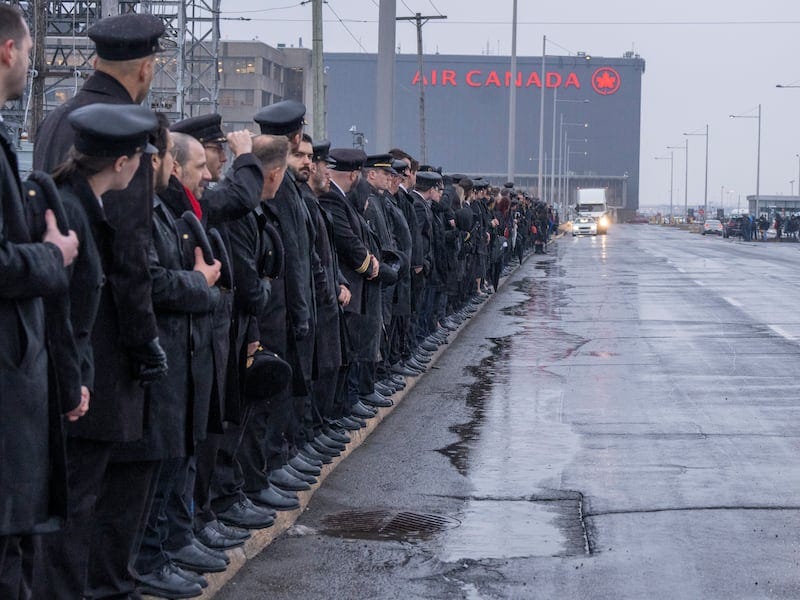
Hundreds of pilots and flight lined the road outside Air Canada headquarters in Montreal on Thursday awaiting the repatriation of the remains of Air Canada Jazz pilot Antoine Forest. Captain Forest, aged 30, and First Officer Mackenzie Gunther, 24, both died when their plane collided with an emergency vehicle at New York's LaGuardia Airport last Sunday.

Defence commitments
Well that wasn’t so hard, was it?
Twenty years after we first agreed to it, twelve years after we formally signed on, and three years after the Washington Post reported that Justin Trudeau had told our allies that we would never do it, Canada has officially met NATO’s defence spending commitment of two per cent of gross domestic product. This is according to the Western alliance’s annual secretary general’s report that was released on Thursday.
Prime Minister Mark Carney took the opportunity to boast of the achievement while touring a naval dockyard in Halifax. “We control our destiny,” Carney said. “In 10 months, we have invested more than $60 billion in our defence and security. That’s the largest year-on-year increase in defence investment in generations.”
It is nice to be out of the doghouse and finally sitting at the big-kids table. But it is a long dinner between the soup and the nuts, and there are a few reasons to be worried about our ability to pull this off.
First: a lot of creative accounting went into making the numbers work.
The federal government got to $63.4 billion in annual defence expenditures by counting spending from more than a dozen departments and agencies beyond the Department of National Defence itself, including Veterans Affairs Canada, the Communications Security Establishment, Global Affairs Canada, and others. In 2025–26, over $14 billion of what Canada is calling “defence spending” comes from these other government departments.
Conservative defence critic James Bezan was blunt about it: the government’s increased defence spending, he said, has “not actually resulted in increased capabilities for the Canadian Armed Forces.” Defence Minister David McGuinty waved the objection off, pointing to independent NATO validation as the final word. But NATO’s accounting methodology is broad by design; it was created to get members across the finish line politically, not to measure battlefield readiness. What NATO counts and what actually makes a soldier more effective in the field are not the same thing.
Second: meeting the 2 per cent target leaves Canada exactly where it has been for much of the last thirty years.
Canada crossed the threshold by the skin of its teeth, landing right at the 2 per cent mark while countries like Poland (4.3 per cent), Lithuania (4.0 per cent), Latvia (3.74 per cent), and Estonia (3.42 per cent) are doing the heavy lifting. Our Arctic neighbour Denmark is at 3.34 per cent. The United States sits at 3.19 per cent. The perennial NATO underachievers of Belgium, Spain, Portugal, and Albania remain Canada’s peer group, at the 2 per cent level.
Third: the new target is 3.5 per cent of GDP, and nobody has explained how we are going to pay for it.
At the NATO summit in The Hague last June, Canada and its allies pledged to reach a new Defence Investment Pledge of 5 per cent of GDP by 2035, made up of 3.5 per cent on core defence and an additional 1.5 per cent on what NATO is calling defence-adjacent security infrastructure (bridges, ports, pipelines, cybersecurity). The Carney government maintains that Canada already meets the 1.5 per cent infrastructure target, but whether that counting survives allied scrutiny is another matter.
The core 3.5 per cent commitment is more daunting. Getting there from 2 per cent, with a GDP the size of Canada’s, will require something in the range of $150 billion annually, or roughly double what we are spending now. Carney’s 2025 budget announced $84 billion in new defence spending over five years, believed to be the largest short-term military cash infusion since the Korean War. But that commitment runs only to 2030, and the bulk of actual procurement, including warships, submarines, and Arctic infrastructure, won’t be paid for or delivered within that window. The bills will be generational, and the fiscal framework to pay them has not been laid out in any detail.
Finally: money is not the same as capability, and Canada has a long history of confusing the two.
The issue is not whether the federal government can write cheques — that is pretty much all it does. But with defence, the question is whether the country can translate those cheques into trained soldiers, operational equipment, and functional procurement pipelines within any kind of meaningful time frame. The evidence here is genuinely mixed.
Take the CH-148 Cyclone maritime helicopter, which was ordered in 2004 to replace the Sea Kings, originally promised for delivery in 2009, and is still not fully operationally capable. This is a story about what happens when defence procurement is driven by political optics rather than operational requirements, which, to be honest, is the story of Canada’s procurement for most of the past forty years.
The new Defence Investment Agency that was created last October is supposed to break the cycle of procurement paralysis. And while staffing a new bureaucracy with the right people while running multiple generational procurement programs simultaneously is not an enterprise with an obvious track record of success, one early sign of hope is the fast-tracking of the new modular rifle.
Additionally, the new submarine project is looking promising. The competition between South Korea’s Hanwha Ocean and Germany’s ThyssenKrupp Marine Systems is moving at genuinely accelerated speed, and a winner may be announced by summer. A decision to buy up to 12 new conventionally powered submarines, aimed at having the first vessels in the water by 2032, would represent a real and necessary capability gain for the Royal Canadian Navy.
So credit where it is due, we cannot say the Carney government hasn’t moved with real urgency on defence. It absolutely has. The political shift is real, as is the spending increase. The CAF also has a great new recruitment campaign going, which suggests it has moved beyond the ridiculous virtue signalling of the Trudeau era.
But the risk now is that the Liberals, having spent a decade claiming the 2 per cent target was a red herring (Trudeau called it a “crass mathematical calculation”), go on to make the opposite error of confusing the target with the outcome. Two per cent was never the point. Three-point-five per cent is not the point either. The point is whether, at the end of this spending surge, Canada has an armed force that can actually defend its territory, secure its Arctic, and pull its weight in a contested world.
We are finally at the table. But it’s a long dinner, and we have barely finished the soup.
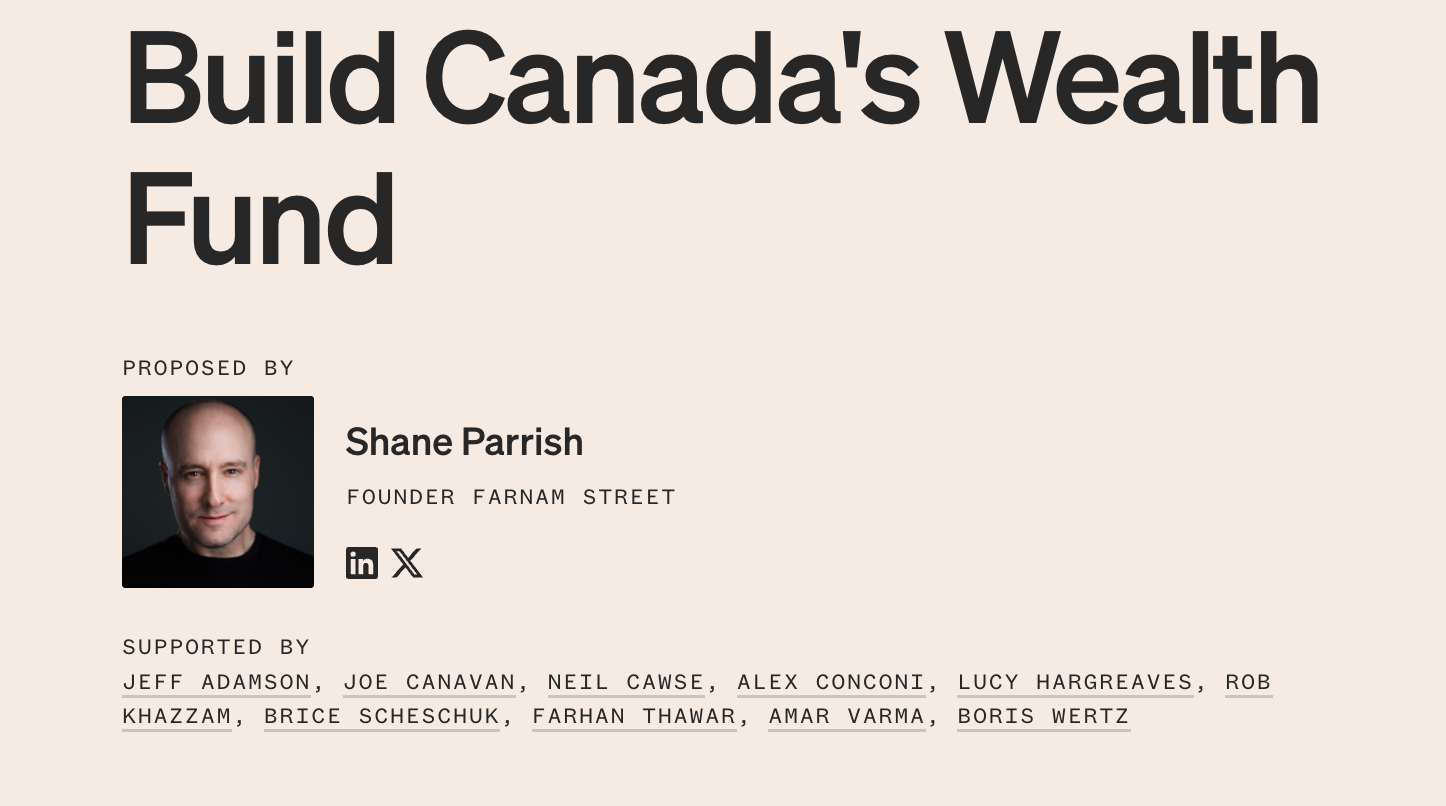
This week’s memo on the Superpower Series outlines a Canadian SWF. A Canadian Sovereign Wealth Fund is more than just economic policy. It’s a promise to each other, and to the generations that will follow. The evidence is clear: Norway’s fund has grown to over $2.5 trillion, helping stabilize its economy for the long term. In Alaska, annual dividends enjoy strong bipartisan support because they put real money in people’s pockets.
We don’t need new taxes to build this. Let’s restore the federal government to pre-2015 per-capita spending levels — exempt the military — and put 75% of the savings into a locked sovereign wealth fund. Give 25% back to Canadians who are hurting right now. Norway has a 2% toll on the world economy. Canada can have the same. It would strengthen our independence, our country, and our position at every negotiating table.
Read more here.
Discussing Housing Affordability in Montreal

Just earlier this week, we hosted former Westmount, QC mayor, Christina Smith and Founder & President of GI Quo Vadis Inc., Dr Natalie Voland at the BDC Building in Montreal to discuss why our current housing models are falling short, where innovation can unlock affordability and access, how policy change can enable better outcomes, and what collaboration across sectors looks like in practice. Thank you to everyone who joined us!
Missed out? Don’t worry - we’ll be sharing the recording on YouTube next week!
Together once again!

Join us next month on April 16 for our Ottawa reception! We’ll be at the Metropolitain Brasserie Restaurant celebrating the builders and policy that move a nation forward. Sign up today by clicking here!
Canadiana
Canadians over, say, 40 (45?) will remember the thrill of coming into class and seeing the reel-to-reel projector set up, the curtains pulled, and the screen lowered. Movie day could only mean one thing: Yet another viewing of Paddle to the Sea, Bill Mason’s wonderful film adaptation of the classic tale of an Indigenous boy who carves a man and a canoe, and sets it on its way…
What else we’ve been reading
Canadian publishing veteran Jacqueline Loch has joined BetaKit as its new General Manager.
Canadian AI firm Cohere has signed a deal with Saab to explore how they can work together on a new global surveillance aircraft.
Energy Minister Tim Hodgson says our Asian and European allies have been calling him asking to buy Canadian natural gas. The Trans Mountain pipeline is at capacity. And Alberta is streamlining is major project approvals.
Build Canada CEO Lucy Hargreaves was Jen Gerson’s guest on this week’s On The Line podcast.
The federal government has failed to enforce its own Indigenous contracting rules.
A photo of snow melting in a park snapped by Ottawa mayor Mark Sutcliffe went viral, and not for good reasons.
The Calgary Zoo is bringing an interpreter to help its new francophone polar bear learn English.
Get weekly, no-fluff insights on building a more prosperous Canada. Tap “Subscribe” now and be first in line for next week’s brief. Then forward this email to one friend who cares as much as you do—let’s build together.
James Bezan called it straight in committee. The government hit NATO's two per cent by folding in 14 billion from departments like Veterans Affairs. I checked the latest notes on open.canada.ca. They confirm those payouts count under alliance rules and put us at 2.01 per cent of GDP this year. It gets us to the table. But turning those dollars into more ships and Arctic-ready forces is still the real test.
I disagree with the idea of a wealth fund and I don't think the article proposing one has seriously thought through the macroeconomic implications.
You can't fund such an endeavour by "cutting government, not by taxing Canadians". A sovereign wealth fund IS taxing Canadians to forcibly increase the savings rate (by definition). This only makes sense with balanced budgets (otherwise, you are borrowing to invest abroad AKA bad) and an exporting creditor economy.
Canada is neither of these things and it is not clear that we should be in the second case. Our resource income per capita is much lower than Norway, Alaska, etc. Our ageing population (and thus potential for future dissaving) is offset by immigration in a way Norway's isn't. It is, fundamentally, not clear that taxing productive activity now to invest in foreign assets will generate higher returns than reducing the tax burden on e.g. private capital instead.