
Canada picks a submarine
Mark Carney arrived at NATO with the biggest defence deal in Canadian history under his arm. The trouble with a promised gift though is that someone eventually expects to unwrap it.
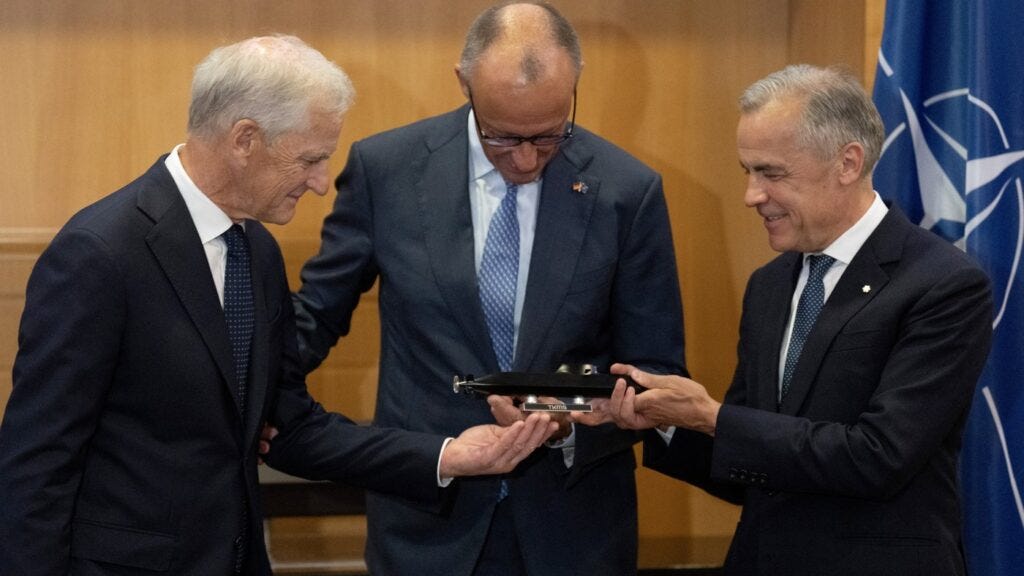

Carney bearing gifts
On his way to the NATO summit in Ankara last week, Prime Minister Mark Carney stopped in Halifax to announce the largest defence procurement in Canadian history. Canada had picked Germany’s ThyssenKrupp Marine Systems as the “preferred bidder” to build up to twelve submarines, beating out its only rival, South Korea’s Hanwha Ocean and its KSS-III boat.
The reported price is around $24 billion for the submarines themselves, and by some estimates as much as $100 billion once decades of maintenance, weapons and infrastructure are folded in. The 212CD is a joint German-Norwegian design, and both countries agreed to give up their own places in the delivery queue so that Canada’s first boats could arrive by 2034, with a final contract targeted for the end of 2027.
NATO Secretary General Mark Rutte had warned allies not to show up empty-handed, and the Prime Minister carried the news to Türkiye like a hostess gift. The choreography peaked on Tuesday when Carney, German Chancellor Friedrich Merz and Norwegian Prime Minister Jonas Gahr Støre gathered to admire a small plastic model of a submarine that will not touch salt water for at least eight years. It was a fitting image for the week: three heads of government examining a scale replica of a capability none of their countries yet possess.
Strip away the staging and there is good news here. Canada is replacing a fleet of four elderly submarines, only one of which is currently seaworthy, with as many as twelve. For a country that claims three oceans and can presently patrol them with a single boat when the weather cooperates, this is a must have, not a nice to have.
But even more striking is the pace. Ottawa named a preferred bidder in under a year and roughly five years ahead of the original schedule. Set against a procurement system that took two decades to not replace these submarines, moving this fast counts as a minor miracle.
There is also a story that goes beyond the boats, and it has to do with the compass bearing. Between the submarines, an $800-million buy of Norwegian Kongsberg strike missiles for the future fighter fleet, a share of a Swedish Saab radar-plane program slated to be largely built here, and the launch of talks toward a Canada-Germany strategic partnership, Canada spent the week tilting quite obviously toward Europe. Merz called the sub decision “bold” and promised “a new era of co-operation.” Canada is also standing up a Defence, Security and Resilience Bank, which will be a Canada-led multilateral lender with eight countries behind it, to pull private capital into allied supply chains.
None of this is happening in a vacuum, and the same American president who wants NATO members to hit a target of spending five per cent of GDP on defence mused yet again this week about taking control of Greenland. Faced with a security guarantor that treats a member state’s territory as a real-estate opportunity, Canada has quietly concluded that its supply chains might be better off running through Kiel and Kongsberg rather than through Washington’s moods. Yet Carney was also blunt about the price of admission: regarding the spending target, he said Donald Trump had won the argument, with Canada now pledging to hit the five per cent target by 2035.
But (and there is always a lot of buts when it comes to this stuff) “preferred bidder” is not a signed contract. That isn’t expected until the end of 2027, and Hanwha Ocean remains on the bench precisely because these negotiations can and do collapse. Also, the pledge to buy “up to twelve” submarines is doing an enormous amount of work, as is the five-per-cent pledge, which the Carney government has announced repeatedly and booked into the fiscal framework not at all. Canada projects it will spend about 2.1 per cent of GDP on defence this year. The gap between that number and five is roughly the entire military capability we have now, doubled.
Then there is the sales brochure. TKMS forecasts it will pump $86 billion back into the Canadian economy and generate 650,000 job-years across the whole project, with torpedo plants in Manitoba, non-magnetic steel in Welland, sub sections in Trois-Rivières and a combat-systems centre in Ottawa. Some of this is genuinely valuable industrial capacity. But the desire to sell every single procurement program as a regional development and jobs program is exactly the instinct that made Canadian procurement so slow, expensive, and ineffective in the first place.
As Philippe Lagassé put it, defence procurement isn’t like buying a car, it is more like deciding to renovate your house. What Canada has undertaken here is a rebuilding of our maritime capacities from their very foundations, and we has only just signed with the contractor. The harder thing, which often seems to be the thing Build Canada exists to nag about, is delivery. Announcing a submarine is trivial, compared to building a torpedo line, a combat-systems centre, and a navy three times its current size, while standing up a defence bank and holding 2,600 troops in Latvia. This is also the sort of work Canada has not done in a very, very long time.
Carney arrived in Ankara bearing welcome gifts. The trouble with a gift you have merely promised though is that, sooner or later, someone expects to unwrap it. Whether there is really a submarine inside the box, and everything else pledged this week along with it, is the work of the next decade.
Build Canada. Actually.
Canada’s greatest adventurer is about to face his biggest challenge yet!
This week in History
July 11: The Lord’s Day Act, banning commerce on Sundays, was passed by Parliament on this day in 1906. It was effectively repealed in 1985, when the Supreme Court ruled it unconstitutional.
July 13: On this day in 1866, the steamship Great Eastern set out to lay the first working transatlantic telegraph cable, completed to Heart’s Content, Newfoundland on July 27, 1866. That’s the moment Europe and North America went from weeks-by-ship to minutes-by-wire communications.
July 14: Happy Birthday Moshe Safdie, the architect known for designing the National Gallery of Canada as well as the world famous Marina Bay Sands in Singapore.
July 15: Rupert’s Land and the North-Western Territory were absorbed into Canada, Manitoba entered as the fifth province, and the North-West Territories were created on this day in 1870. It was the largest real-estate transaction by land area in the country's history and transformed Canada from a modest northeastern country into a continental empire.
July 17: On this day in 1897, the Portland steamship carrying Klondike gold docked in Seattle — igniting the gold rush and sending thousands through Canadian ports and supply towns,
At the Stampede!
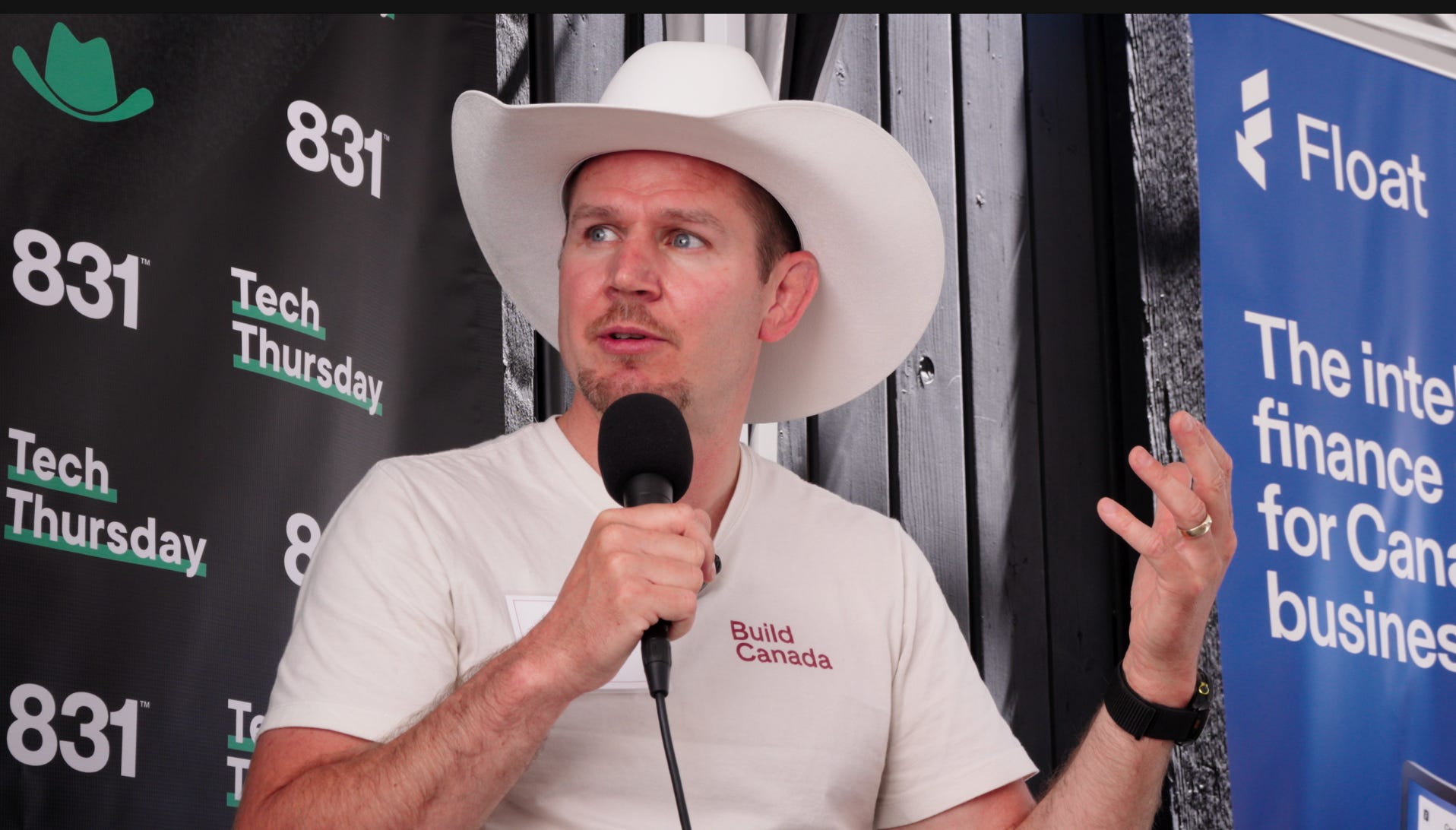
Jeff Adamson, CEO of Neo Financial, sported a Build Canada tee while leading the Fintech Panel at the Stampede Tech Summit, hosted by House 831 and Tech Thursday, on July 6th. Photograph by Arvin Farsyad.
Build Canada Merch!
The highly requested merch shop is once again open after a brief inventory outage. Looking to grab something for those summer days by the water? Head over to 🛒: shop.buildcanada.com


Great Canadian Builder: Jack Poole
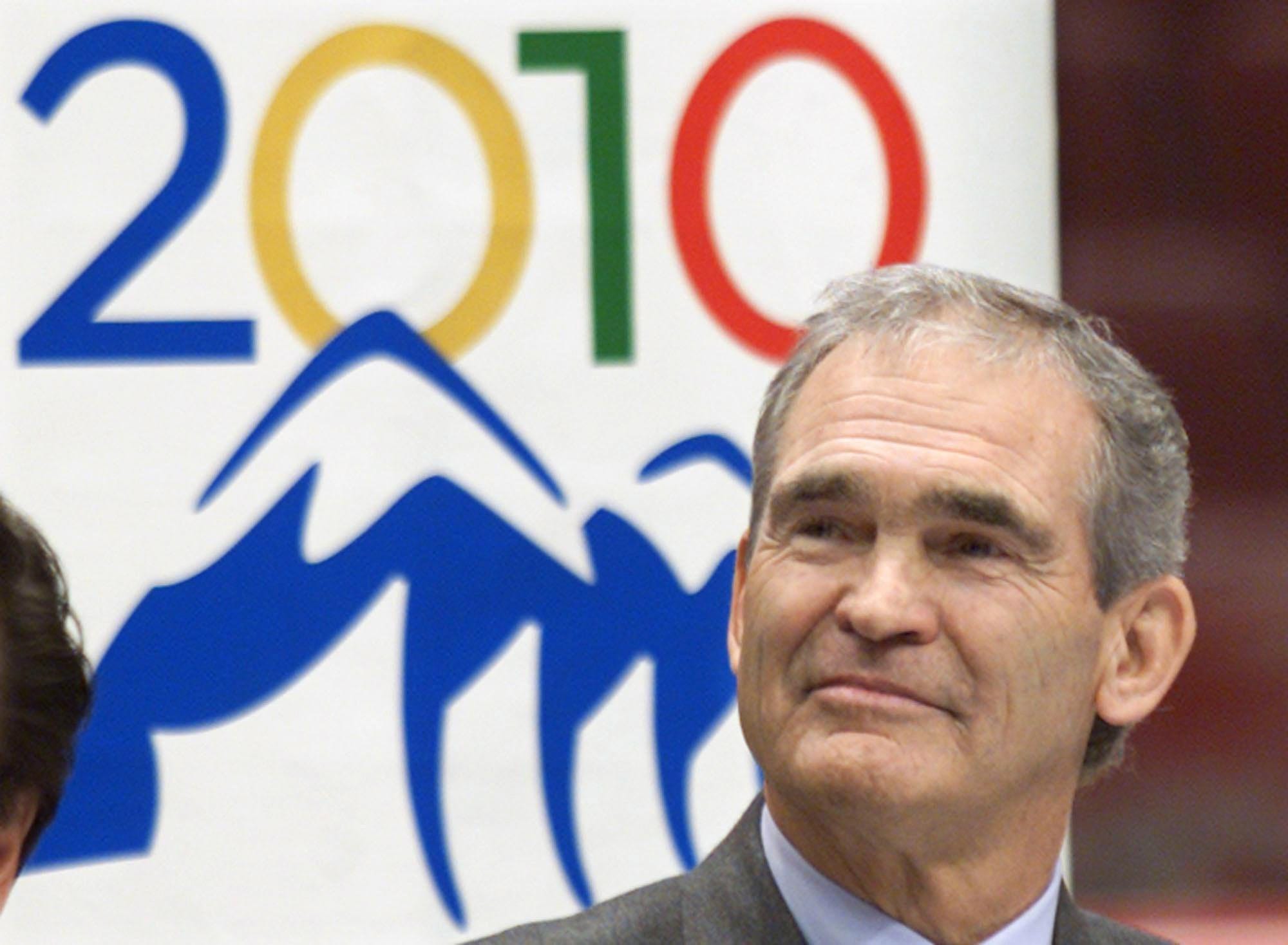
“I don’t have any money, but I’ll sign over everything I’ve got.”
Over the past few weeks, whenever TSN’s World Cup panel threw to the crowds gathered outside its downtown set, viewers were looking at Jack Poole Plaza, the waterfront square beneath the Olympic cauldron, with the North Shore mountains looming in the background. Tens of thousands of soccer fans passed through without the faintest idea who Jack Poole was.
Jack Poole is the reason the 2010 Winter Olympics came to Vancouver and Whistler, and those games are still the largest event of any kind ever staged in British Columbia. In 2001, semi-retired and 68, he took a call from newly elected premier Gordon Campbell and agreed to chair the city’s Olympic bid for a salary of one dollar a year, expenses out of his own pocket. Decades earlier, Poole’s development company had given a teenaged Campbell his first paying job, as a labourer on a housing project at Babine Lake; the two liked to joke that Campbell had squared the account by handing Poole his last. For two years he ran the Vancouver 2010 Bid Corporation as volunteer chairman, doing the unglamorous work a Games actually demands to align three levels of government, the sports federations, and First Nations behind one vision. Vancouver won the vote in July 2003, and Poole stayed on to chair the organizing committee.
He never saw it. Poole died of pancreatic cancer shortly after midnight on October 23, 2009, just a few hours after the Olympic flame was lit in Olympia, Greece, beginning the torch relay toward the Games he had spent eight years securing. The plaza and the cauldron were named for him afterward. That the same patch of ground is now the natural gathering place for World Cup crowds is his legacy.
Before any of this though, Poole was a builder in the plainest sense. Born in 1933 in Mortlach, Saskatchewan, he took a civil engineering degree from the University of Saskatchewan, married at 17, and moved west. In 1964 he co-founded Daon Development Corporation on little more than nerve and a signed-over house, and built it into the second-largest real estate development company in North America. Then the 1982 recession destroyed it. Daon collapsed into bankruptcy protection, and Poole, once worth $100 million, was left broke, divorced, and holding the debts.
What he did next is the part worth remembering. He started over, co-founded what became Concert Properties, and rebuilt it into one of the largest developers in the province. The boom, the bust, and the refusal to stay down: that is the whole Canadian builder story compressed into one career.
It is also exactly the temperament he brought to the Olympics, with the same instinct to take on something enormous, carry the risk personally, and see it through to the finish.Vancouver is a world sporting city today because a developer from Mortlach decided it should be. The plaza is the least the city owes him.
What else we’ve been reading
At Montreal’s Startupfest, Harley Finkelstein talked about what Canadian founders need to do differently
Federal public servants are now required to be in the office four days a week. They aren’t happy about it.
Calgary economist Trevor Tombe has some ideas for making equalization less complicated, and better for national unity.
From Be Giant, a profile of theoretical physicist Sabrina Gonzalez Pasterski, the head of the Celestial Holography Initiative at the Perimeter Institute in Waterloo.
Three months after his trip around the Moon, astronaut Jeremy Hansen is retiring from the Canadian Space Agency.
Get weekly, no-fluff insights on building a more prosperous Canada. Tap “Subscribe” now and be first in line for next week’s brief. Then forward this email to one friend who cares as much as you do—let’s build together.
do we really need manned submarines, with so many failed defense projects we should be going autonomous as much as possible. We're just throwing money around for the sake of throwing money around without much thought to it all. (smart https://www.saab.com/products/autonomous-ocean-drone dumb https://www.ctvnews.ca/canada/article/bombardier-wont-contest-ottawas-sole-source-deal-on-new-boeing-military-planes/ ) why can't we build stuff anymore? not capable? too dependent on others now? sure would be nice to see some real engineering work, its been a decade now I've been looking and all I encounter is over priced pencil pushing jobs and failure esp in defence contracts (milk the mess raise the ranks the motto). Need small is good simple is smart thinking with AI data centers too -distribute specialized data centers not monster giant owned data centers.