
A bridge over dividing waters
A span built as a symbol of Canada-U.S. partnership opens this week as a monument to its collapse.

Canada sketches a Plan B
On July 26, 1923, some fifty thousand people packed into Stanley Park to hear Warren Harding speak. He was the first sitting American president to set foot in Canada, and Vancouver received him accordingly with a twenty-one-gun salute from the Canadian Field Artillery as the city thrilled at its own sudden importance. Harding rewarded them with a sermon on the miracle of the undefended border. “No grim-faced fortifications mark our frontiers,” he declared, “no huge battleships patrol our dividing waters, no stealthy spies lurk in our tranquil border hamlets.” The friendship between the two nations, he assured the crowd, required no written guarantee to endure. It was, he said, a friendship that consisted “not of perishable parchment, but of fair and honourable dealing, which, God grant, shall continue for all time.”
He then played a few holes at Shaughnessy, begged off early because he wasn’t feeling well, continued down the coast on his speaking tour, and was dead within the week. Yet the words he spoke in Vancouver were carved into granite in Stanley Park where he had spoken, and there they remain, on a monument most passersby now find inscrutable, to a president most Canadians have forgotten, celebrating a proposition this week’s news has pretty much demolished.
Harding had it precisely backwards. His confidence was that the relationship between Canada and the United States was too sturdy to need a document, but the lesson of the past eighteen months is that the documents we do have are worth almost nothing at all. This week, Donald Trump imposed fifty per cent tariffs on a long list of Canadian goods, from wine to cement to hockey sticks, that will apply whether or not those goods are covered under CUSMA. The continental trade agreement his own first administration negotiated and signed did not slow him down for an afternoon.
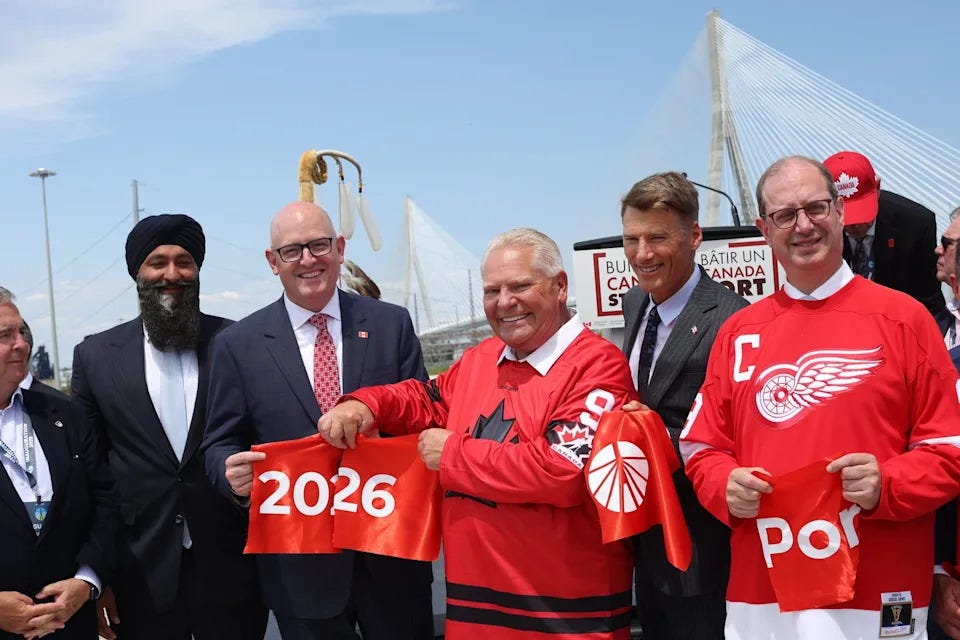
Nothing illustrates the point better than the saga of the bridge. The Gordie Howe International Bridge — built at a cost of $4.7 billion, financed entirely by Canada, connecting Windsor to Detroit — is scheduled to open to traffic on Monday. It was conceived as the physical embodiment of Harding’s thesis, but instead it stands as a monument to hard feelings. Earlier this year Trump demanded, as the price of allowing it to open, that Canada hand over half the ownership and a share of the tolls on a structure it had paid for, complaining that it had been built with too little American steel. On Friday, after the new round of tariffs landed, Ottawa cancelled the joint ribbon-cutting that was scheduled and held its own ceremony on the Windsor side, with no Americans invited.
All of which is probably necessary, if somewhat unsatisfying theatre. But the problem facing the Carney government, and Canadians more generally, is that despite persistent American complaints about Canadian retaliation, our response to the tariffs and other forms of economic strong-arming by the U.S. has been largely theatrical. Carney is facing increasingly loud calls to get tough, to fight back, to stand up for Canada and Canadians. And while the prime minister said this week that “everything is on the table” when it comes to responding to the new tariffs, his options are limited – as the Americans well know.
First of all, the hit from the tariffs will be unevenly distributed across the country, making a unified national response pretty difficult. Second, the U.S. has already made it clear that they will tolerate no pushback or retaliation whatsoever – that the tariff hit is only allowed to go one way.
So any big blunderbuss response is probably not on the table. Instead, the more consequential Canadian response to what is coming from Washington is happening elsewhere, and it amounts to something Harding (and his Canadians audience) would have found unthinkable: a grim-faced Canada is rebuilding the fortifications.
Consider the week’s defence file, which ran alongside the tariff drama and drew a fraction of the attention. On Monday, Canada became the first observer nation in the Global Combat Air Programme, the British-Italian-Japanese effort to build a sixth-generation fighter. This is happening even as the government’s order for eighty-eight American F-35s sits under a “review” now in its sixteenth month.
Of course, observer status in the fighter programme means no money committed, no industrial workshare, and no vote. At best it gives Canada possible future options, while signalling that we are willing to redirect our attention and our alliances.
It is of a piece with the rest of the week. In Charlottetown, the premiers finally agreed to let Canadians buy wine and spirits shipped from another province, and to work toward recognizing one another’s workers by year’s end — an overdue effort to thicken the domestic market now that the export one has turned difficult. The logic is the same as the fighter file: If you cannot count on the customer next door, you build alternatives, at home and abroad, and keep every door ajar. It is less a strategy than a hedge, the posture of a country quietly arranging a Plan B before it has to name one.
Still, the direction is unmistakable, and it is the reverse of everything the granite in Stanley Park promises. Harding swore that no battleships would ever patrol these waters. A century on, his hosts are buying twelve submarines from Germany. The compact of fair and honourable dealing that Harding spoke of has expired. What might replace it is the very thing he was so sure we would never need.
This week in Building Canada
July 25: Fought on this day in 1814, the Battle of Lundy's Lane was the bloodiest engagement of the War of 1812 and the deadliest battle ever fought on Canadian soil. Taking place near Niagara Falls, Ontario, the gruelling close-range combat lasted well into the night, ending in a bloody, inconclusive strategic stalemate.
July 26: Warren Harding became the first sitting U.S. president to visit Canada, stopping off on Vancouver in his way back from Alaska in 1923. He died exactly one week later, on August 2.
July 27: On this day in 1921, Frederick Banting and Charles Best produced the first working pancreatic extract in their laboratory at the University of Toronto.
July 30: The Trans-Canada Highway was officially opened on this day in 1962, sort of. It actually had two official openings thanks to federal-provincial spite: BC premier W.A.C. Bennett held his own ceremony at Revelstoke on July 30, 1962, calling it “BC Highway 1,” then boycotted Prime Minister John Diefenbaker’s own opening at Rogers Pass on September 3 in protest over the funding deal.
July 31: Summer is fleeting. Get outside!
Build Canada Merch
Looking to grab something for those summer days by the water? Head over to 🛒: shop.buildcanada.com


IMAX and The Odyssey
The movie event of the summer is a three-and-a-half-hour adaptation of Homer, and at the heart of the experience is a Canadian invention. IMAX was dreamed up by four Canadians who founded the company in Montreal in 1967 and sketched the name, short for “maximum image,” on a restaurant placemat. Their first permanent screen opened at Toronto’s Cinesphere in 1971.
The Odyssey is the first feature ever shot entirely on IMAX 70mm film, and is the fulfilment of the founders’ original dream — a Hollywood epic in the format’s largest, purest form. Audiences are lapping it up. The Odyssey had a $124.5-million opening weekend, nearly a quarter of the North American gross claimed by IMAX’s own screens, pushing the company’s share price to near its highest levels since the company went public in 1994.
The Canadian at the heart of this movie’s story, though, is a quieter figure. David Keighley, born in Toronto in 1948, was IMAX’s first chief quality officer — the man who, for five decades, made certain the image on the screen matched the ambition behind it. He oversaw post-production on more than 500 films; for years, no IMAX print left the lab without his personal approval. He reviewed the dailies for The Odyssey just days before he died last August, at 77. The film closes with a dedication to him, and the new camera built to shoot it is called the Keighley.
What else we’ve been reading
One of our new favourite Substacks is The Canadian Explorers by Ethan Marcoux. This week he has a great interview with Matthew Lombardi, founder of the Icebreaker newsletter on Canadian defence.
University of Toronto math professor Jacob Tsimerman has won a 2026 Fields Medal, the top global honour in mathematics. Over at Be Giant, Luc Rinaldi has a good profile of Tsimerman.
According to David Coletto at Abacus, socialism is back in the conversation — 39% of Canadians under 30 view it positively. Among those 60 and over, 21% do. Read his analysis here.
It’s been over a year of Donald Trump’s tariff war on Canada, and polls show Canadians increasingly want to put up a fight.
The McFlurry was invented in the summer of 1995 a McDonald’s franchise owner in Bathurst, New Brunswick. Now the city wants to erect a monument to celebrate the tasty treat.
Get weekly, no-fluff insights on building a more prosperous Canada. Tap “Subscribe” now and be first in line for next week’s brief. Then forward this email to one friend who cares as much as you do—let’s build together.
Who is stuck paying for the bridge? stuck with the bill again, we always get shafted as good co/dependents dancing with the narc, we love to dance with our wild one's as we beg and plea take us back lets lovebomb again in our wicked ways.
Great article, thanks.